The detailed form now sends pitches and editorial applications through Field Assembly's email service. A delivery reference means the service accepted the message; it does not confirm inbox arrival or editorial review.
Read the changes
What changed
Enabled direct sending from the detailed form, with a prepared-email option if direct delivery is unavailable.
Updated the privacy notice to describe the services handling direct delivery and the shared sending limit.
Editorial note
Editorial consideration is free. Submitting does not transfer rights or guarantee publication or an individual reply.
02
People / places / navigation
A map of places in the published work
The Places map is now linked from the People page and the homepage. It shows locations documented in published work, not where readers live or how many people visit.
Read the changes
What changed
Added a direct route from People to the map and made Places easier to find from the homepage.
Kept the map grounded in locations named in the published work; it does not report audience analytics.
Editorial note
The map describes the geography of the work, not readership or visitor counts.
03
Issue 01 / credits / publication record
Correction to Issue 01 editorial credits
Issue 01 was edited by Hemant Jindal. Anindita Shrivastava and Nishtha Gupta contributed their own projects and essays; they did not edit the issue.
Read the changes
What changed
Corrected the earlier editor credits across the current web edition, citations, search results and structured publication data.
Added a visible correction and a statement explaining how Issue 01 was selected and edited, including the editor’s own work.
Replaced unmeasured audience targets with a map of places documented in the published work. The map does not represent readership.
Restored direct links from the essay index to its underlying projects, and aligned the homepage and footer publication descriptor.
Editorial note
The 6 September PDF edition is unchanged and carries the earlier editor credits. See the correction on the Issue 01 page. Previous update entries and original research-team credits are preserved.
04
People / research / reading experience
The people behind the published work
Meet founder Hemant Jindal, featured authors Nishtha Gupta and Anindita Shrivastava, and Contributing Editor Carole El Danaf through their work.
Read the changes
What changed
Recomposed the profiles for desktop and mobile, with direct paths to studies, essays and sources.
Connected Nishtha’s working paper directly from her profile and shortened the introduction to Resilient Metropoles.
Separated platform ownership, contributor roles and original project authorship across the web edition.
Editorial note
Original team credits and each contributor’s editorial involvement remain visible. The downloadable September 6 edition retains its dated masthead.
05
People / reading guides / open tools
Carole El Danaf joins the editorial masthead
Carole’s Contributing Editor profile now connects Hinterland (individual LAU final-year work, 2019–20) and METAXIS (collaborative AADRL studio work, 2023–24).
Read the changes
What changed
Published two selected works with original sources and credits: Hinterland (individual final-year work, LAU, 2019–20) and METAXIS (collaborative AADRL studio work, 2023–24).
Simplified introductions and section navigation across the web edition; original study images and source records remain accessible.
Placed the submission form before detailed guidance and shortened the tools index.
Editorial note
The existing three senior editorial roles and all original research team credits are unchanged.
06
Issue 01 / downloadable edition
Original research sequences enter the Field Edition
The 24-page edition now carries the original Resilient Metropoles figures alongside Food Park and the Skin Machine material studies.
Read the changes
What changed
Published the six-part metropolitan sequence with complete research-team credits.
Aligned the printed research order with the web edition: Food Park, Resilient Metropoles, Skin Machine.
Recorded the cleared Skin Machine booklet and the published Food Park position.
Editorial note
Take a Seat remains an open field protocol. Original Food Park drawings are not included in this edition.
07
Work / editorial lead / evidence
Resilient Metropoles: six connected studies
Original project drawings trace the relationships between economic actors, water, streets and building types, with the full research team credited.
Read the changes
What changed
Published one opening visualisation and a six-part sequence covering economic actors, water behaviour, physical testing, emergent streets, building types and spatial consequence.
Added Nishtha's 2026 SSRN working paper as continued research without presenting it as peer-reviewed work.
Updated the project introduction, journal and sources, with links to Nishtha’s related research.
Editorial note
The research sequence includes full team credits, original sources and the limits of the studies.
08
Issue / tools / public record
Issue 01 published online
The Public Act brings together three architectural studies, three essays, two browser tools and a printable fieldwork guide, with sources and credits.
Read the changes
What changed
Published the 25-plate Skin Machine Material Failure Atlas.
Published Food Park and Resilient Metropoles with the research material available for the web edition.
Published a 24-page field edition, Field Kit, Food Space Planner and Take a Seat action pack.
Editorial note
Take a Seat is published as an open protocol; completed field accounts are published separately.
Website maintenance history
Clearer contact, tools and form recovery
Readers can open the Food Space Planner directly, email the editorial desk about corrections and rights, and choose how a detailed form working copy is kept in their browser.
Added a direct Food Space Planner page while keeping the planner in Food Park.
Made the existing editorial email visible from the People contact section.
Changed new detailed-form working copies to the current tab by default, with an optional device copy for up to 30 days without use; the Privacy notice explains the choice.
Privacy notice clarified for submissions
As of 25 September, the form prepared a message for the visitor to send and did not deliver it or issue an automatic receipt.
Removed wording that described a planned email service and shared sending limit as if they were active.
Clarified that an unsent submission stays in the visitor’s browser and that sent correspondence passes through their email provider to the editorial inbox.
Clearer page guides and tool instructions
Revised page summaries, research captions and contribution guidance to explain the work and the tools more directly.
Clarified what each tool needs, what it produces and how to use the results.
Simplified research explanations while retaining original team credits, sources and research limits.
Updated submission guidance, audience-map descriptions and page-not-found help.
Clearer navigation and publication details
Shorter introductions lead to the full research, with publication details and a citation on each authored page.
Stopped route changes from visibly scrolling through the destination page.
Routed public contact through verified editor profiles until a collective inbox is connected.
Updated citations, page links and revision dates.
A shared design for the publication
Reorganised the website so readers could distinguish the journal, projects, people, essays, tools and source records.
Added consistent page navigation and section links.
Revised the layouts for research, people and fieldwork.
Kept the interactive homepage opening and restored the original people cards.
Issue 01 / 6 Sep 2026 / 24 pages
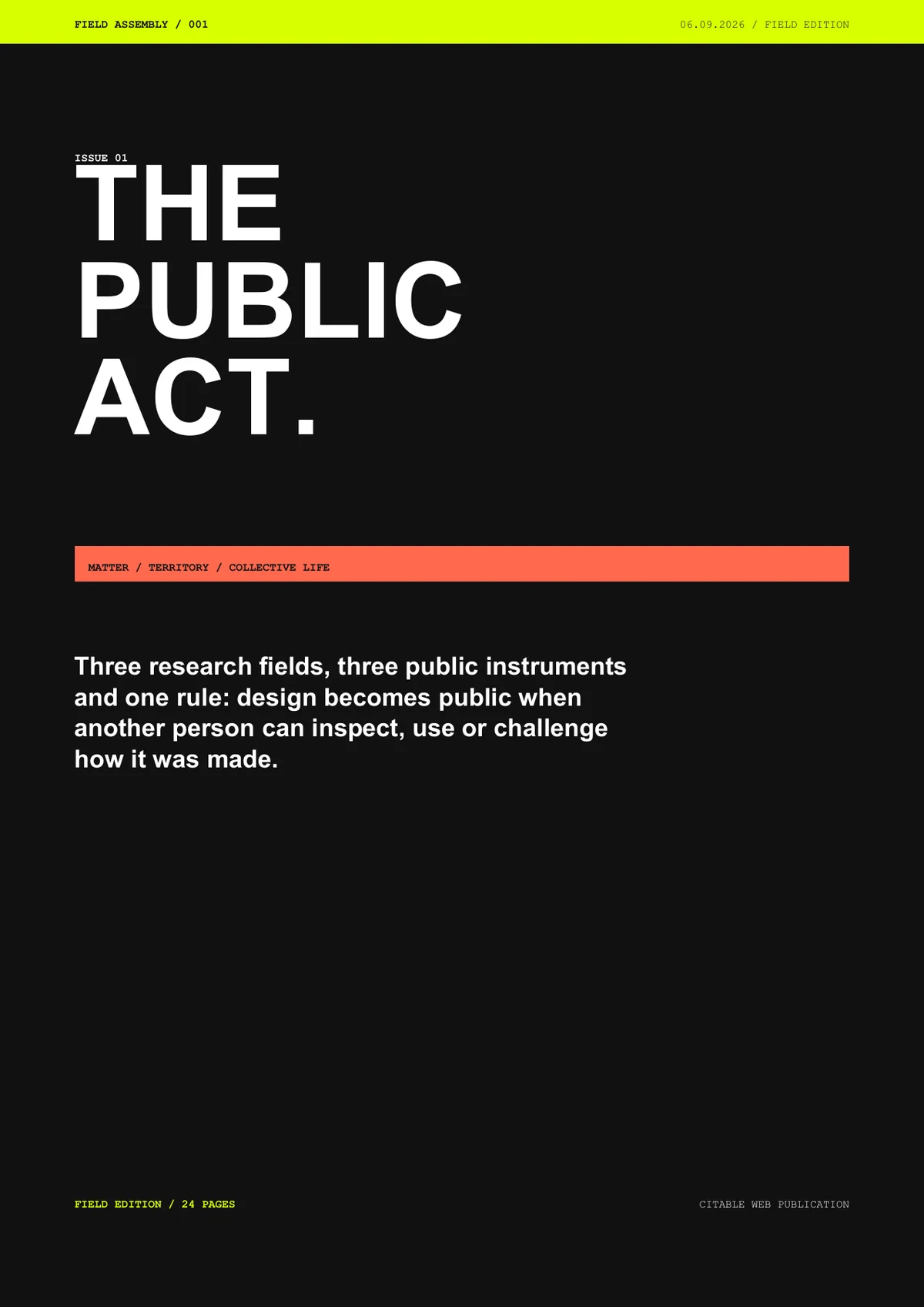
Read the field edition.
Research, essays and field guides from Issue 01. The PDF retains earlier editor credits; read the dated correction.