Cultivated matter / Hemant Jindal
Cultivation is fabrication.
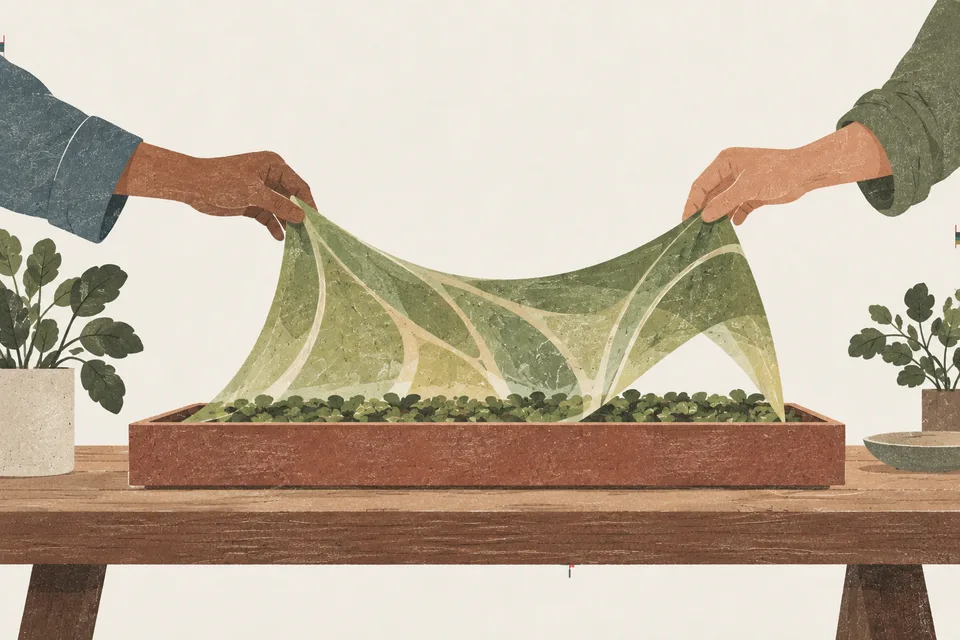
Editorial illustrations / Field Assembly
Manufacturing usually begins with a material that is cut, pressed or assembled into a predetermined form. Cultivation begins from a different fact: living and semi-living materials already grow, shrink, bind, respond and fail. Their behaviour is not noise around the design process. It is the process.
The architect's role consequently shifts from specifying a finished surface to organising conditions. Nutrient, humidity, scaffold, duration, drying and rehydration become design variables. Form emerges through feedback between those variables and the material rather than through the one-way execution of a drawing.
That change makes failure productive. A sheet that tears at a frame, shrinks unevenly or loses translucency is not merely a rejected specimen. It identifies a limit, a dependency or a new path of assembly. Recording those events produces a more credible material culture than selecting only the most seductive outcome.
Skin Machine tests this approach through bacterial cellulose. Its archive moves from cultivation to binding, deformation and a larger machine study. The work demonstrates observed behaviours and experimental assemblies; it does not certify a construction product. The findings describe material experiments, not verified building performance.
Cultivated matter becomes architecturally meaningful through an open testing culture. Protocol, specimen, failure and next test must travel with the image so possibility is not confused with performance. This demands patience as a design competency: the time of growth cannot be treated as a delay before the real work begins. Fabrication then becomes less an act of command and more a disciplined negotiation with growth.
Research behind the essay.
Skin Machine records 25 material plates in which drying, deformation and failure direct the next test.
Protocol, specimen, failure and limit must travel together if cultivated matter is to become architectural knowledge.