State changes the material
Wet and dry states alter thickness, transparency and deformation.
Skin Machine / Atlas
Issue 01 / Cultivated matter
Twenty-five plates trace a living sheet through growth, drying, binding, deformation and spatial assembly.
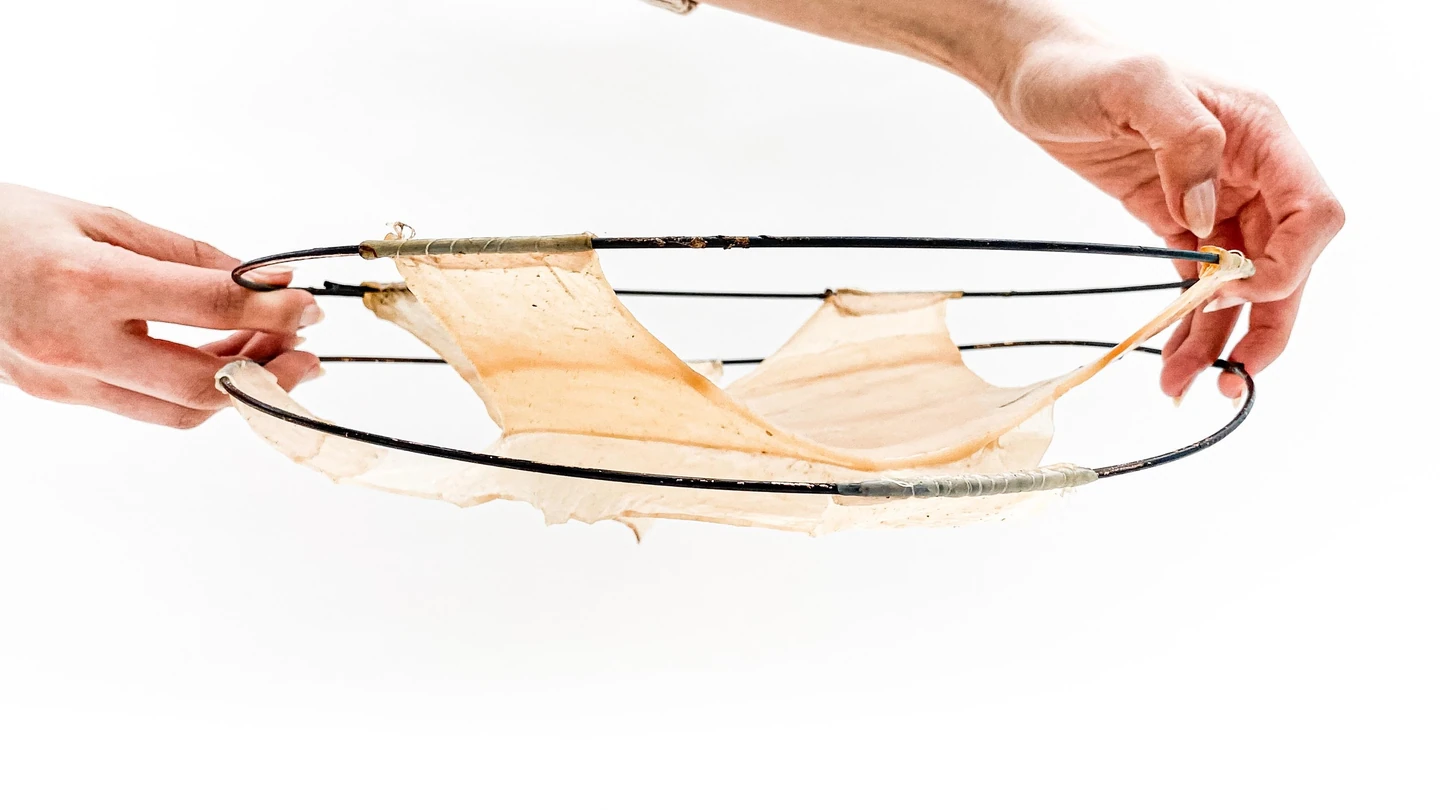
The question
Bacterial cellulose forms a sheet that can be lifted, dried and attached to a frame. This research asks how its changing behaviour can help form an architectural membrane.
What the tests show: drying alters dimensions and stiffness; frame connections influence motion; inflation explores enclosed volume. The four findings below connect observed changes to the next experiment. They do not establish a certified building material.
Read the test findingsFive routes from growth to assembly.
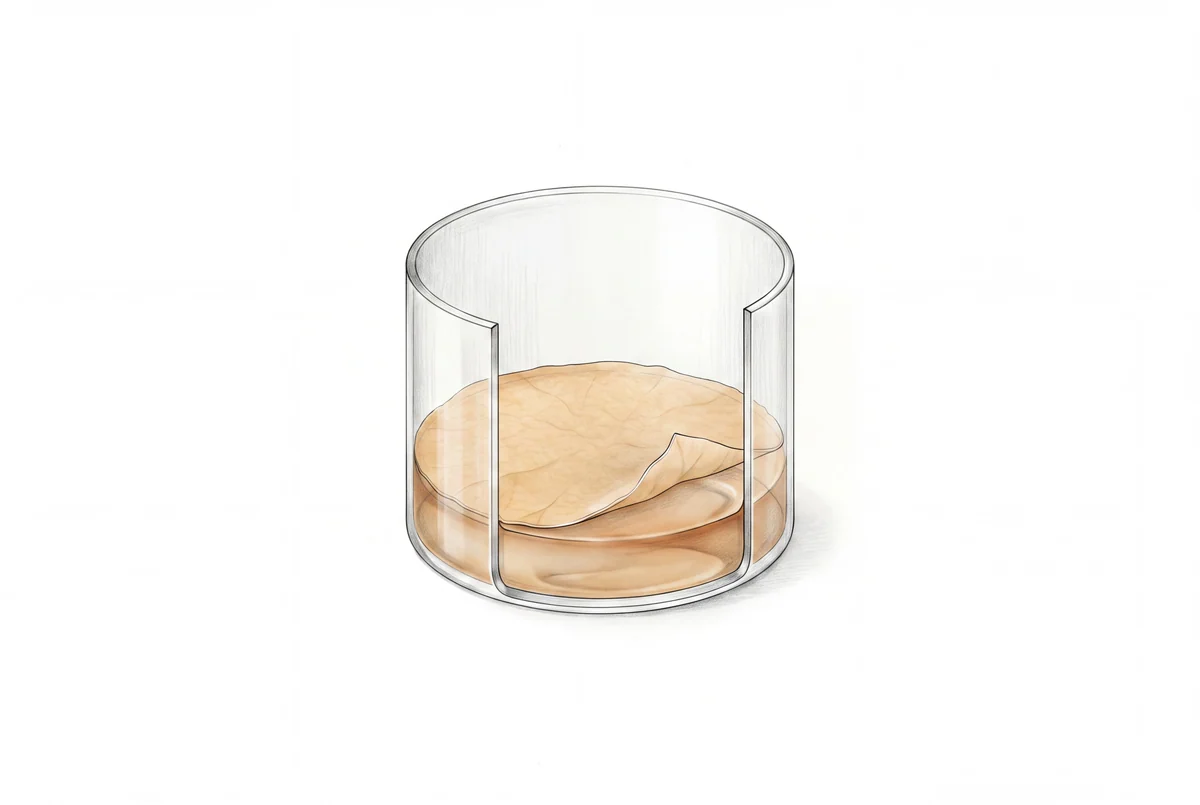
Growth surface and vessel. Open the cultivation record.
Editorial illustration / Field Assembly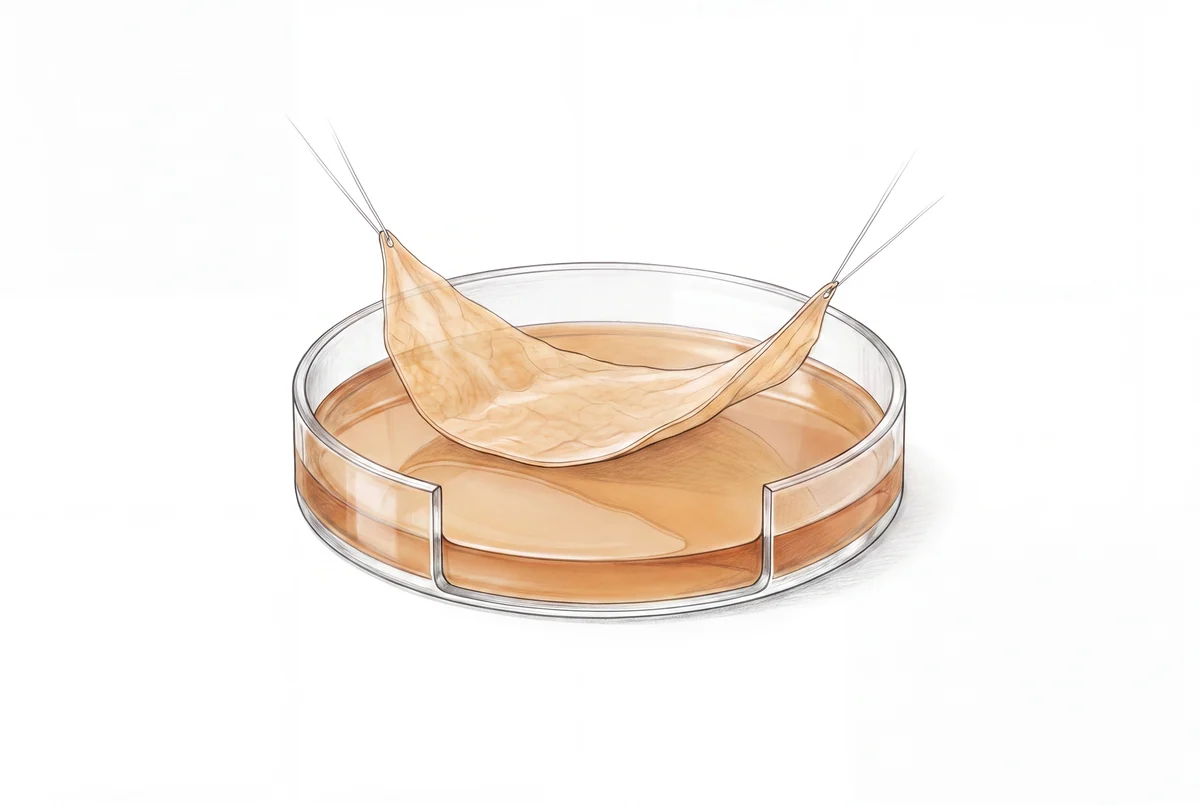
Lifted layers; compare the continuous-growth study.
Editorial illustration / Field Assembly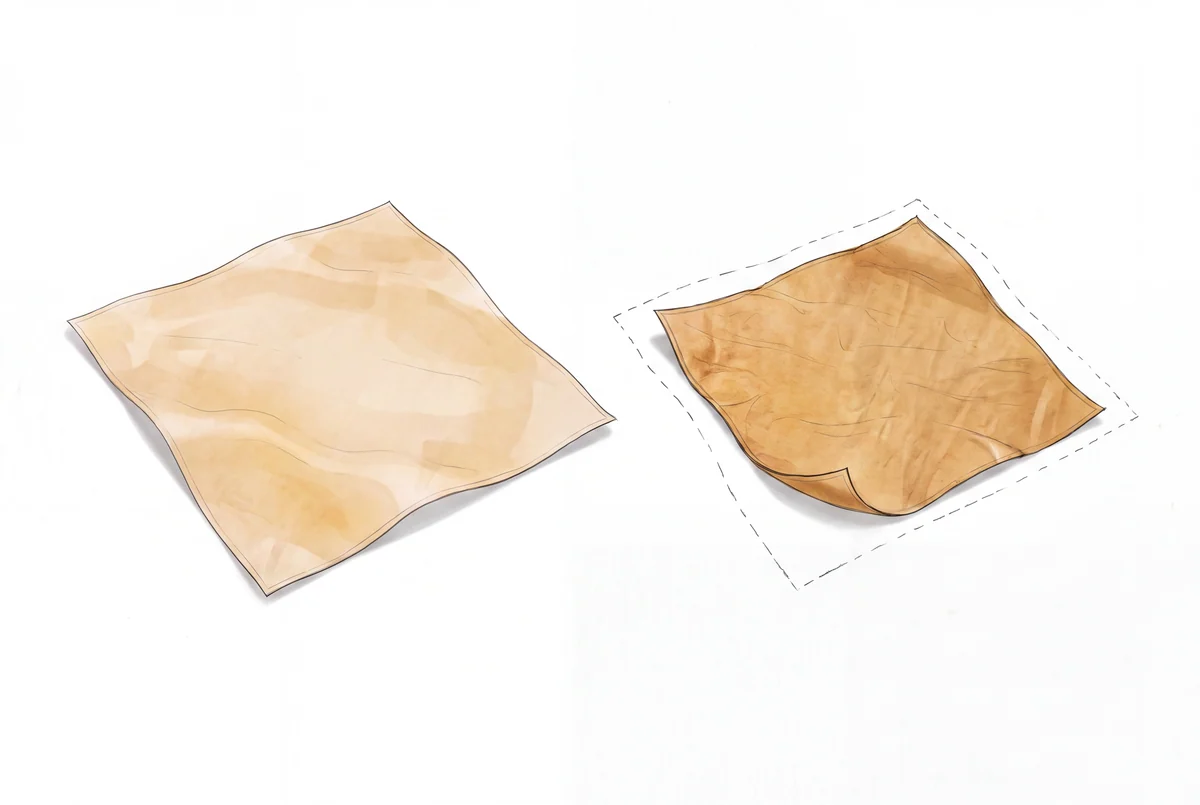
Drying changes the outline; see the transformation plates.
Editorial illustration / Field Assembly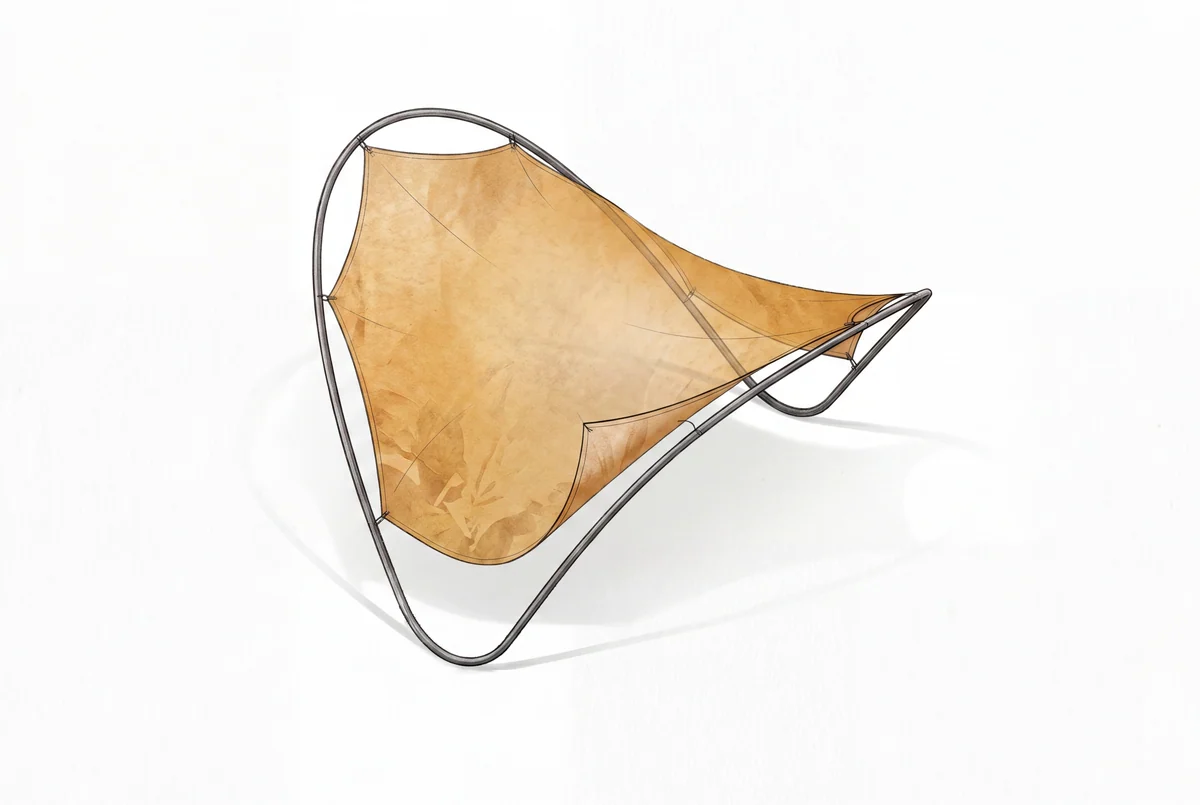
Frame edge and membrane motion; open the motion studies.
Editorial illustration / Field Assembly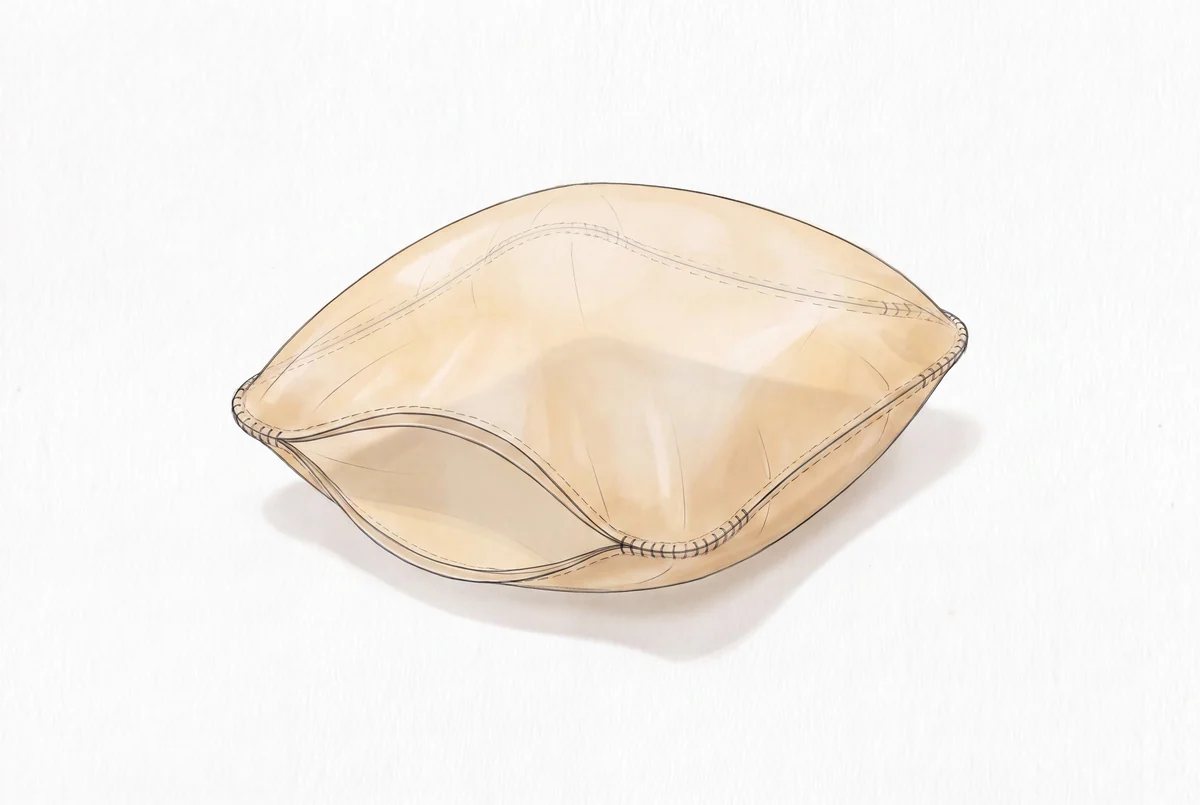
Joined skins can hold volume; no airtightness, strength or durability claim.
Editorial illustration / Field AssemblyWet and dry states alter thickness, transparency and deformation.
Wrinkle, tear, contraction and contamination become experimental evidence.
Contraction and deformation are explored as inputs for an unbuilt active system.
Material Failure Atlas / 004
A fibre can appear integrated while bond strength and failure mode remain unknown.
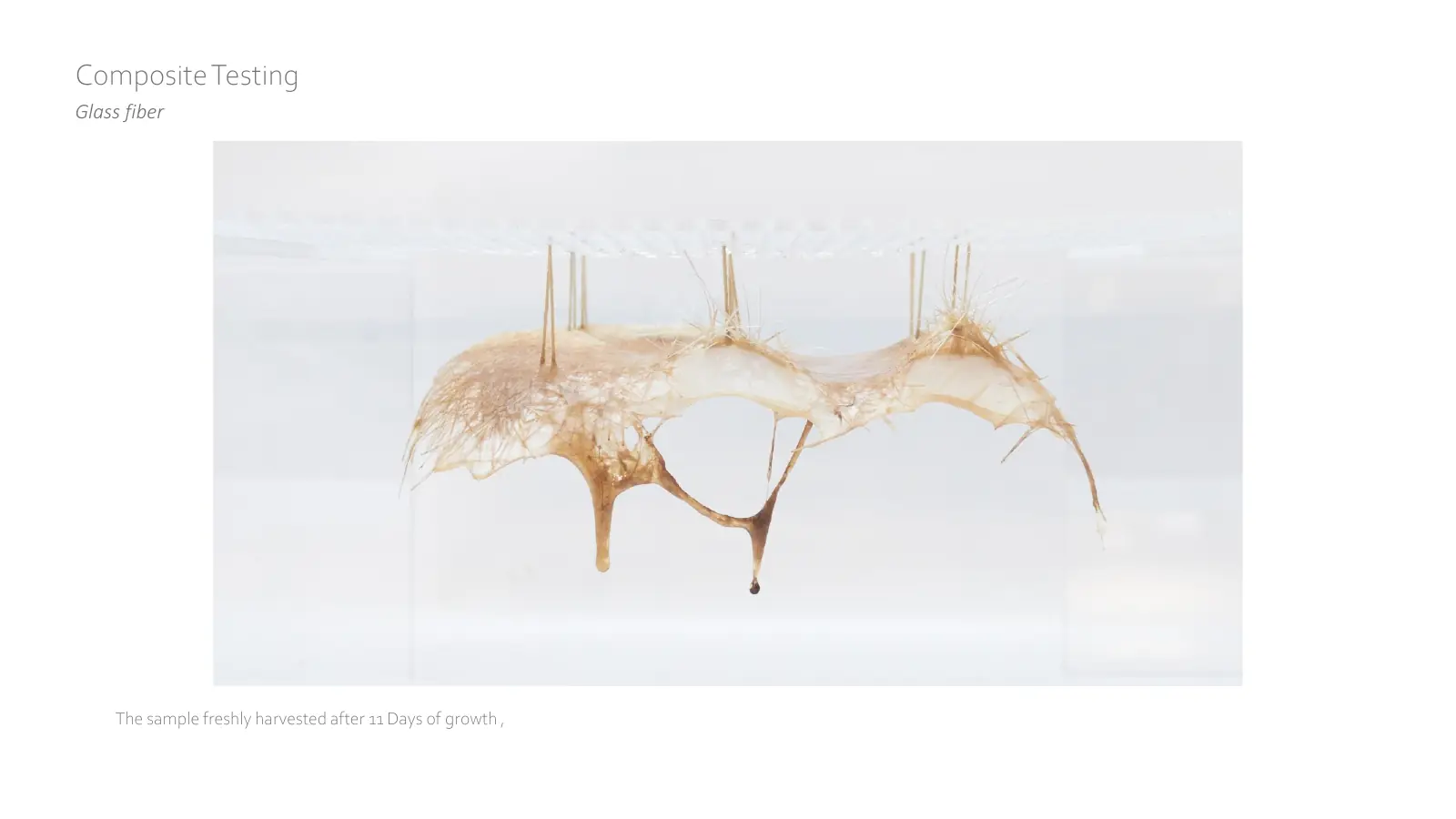
Drying changed thickness and length; wet geometry could not be treated as finished geometry.
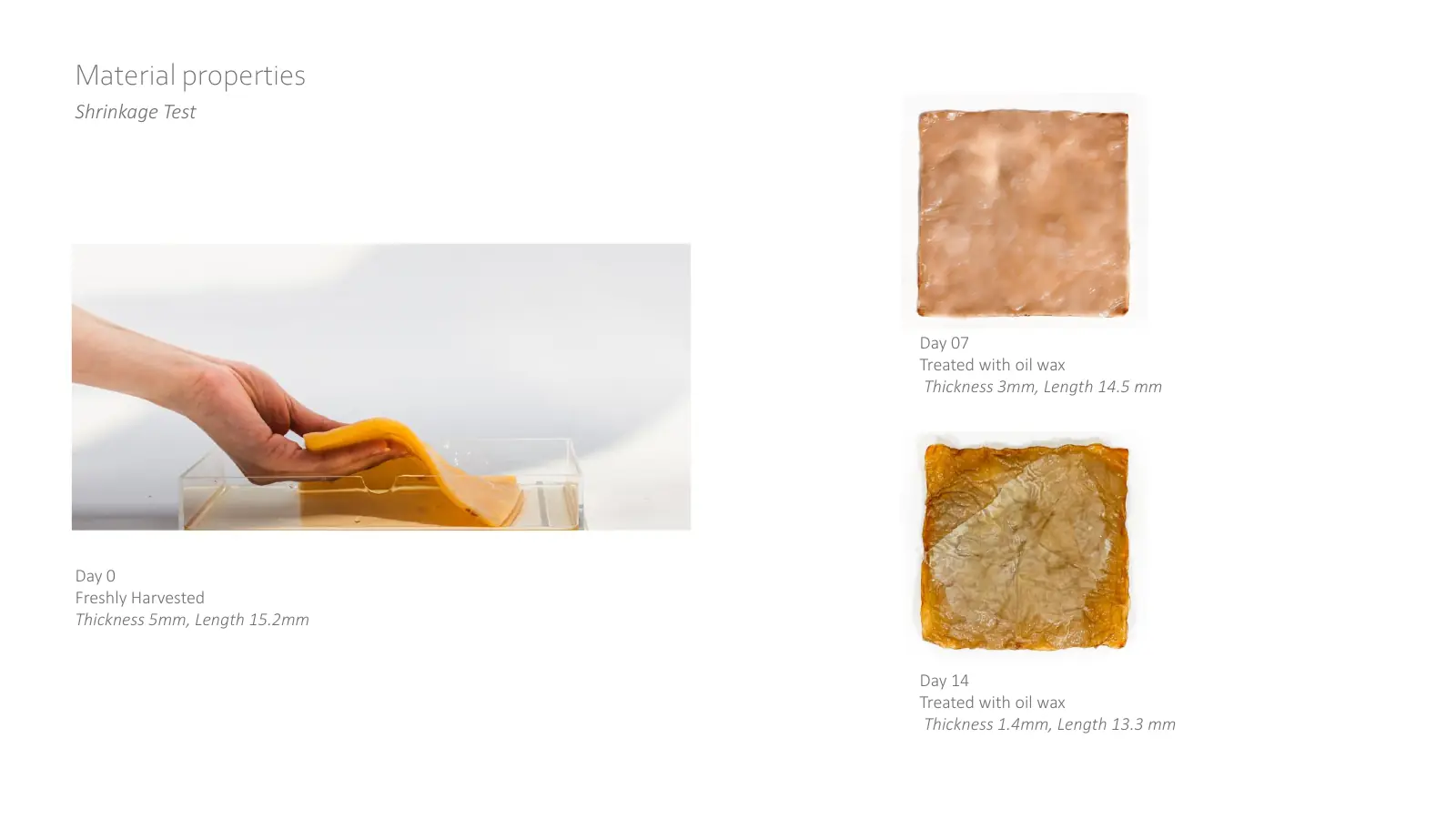
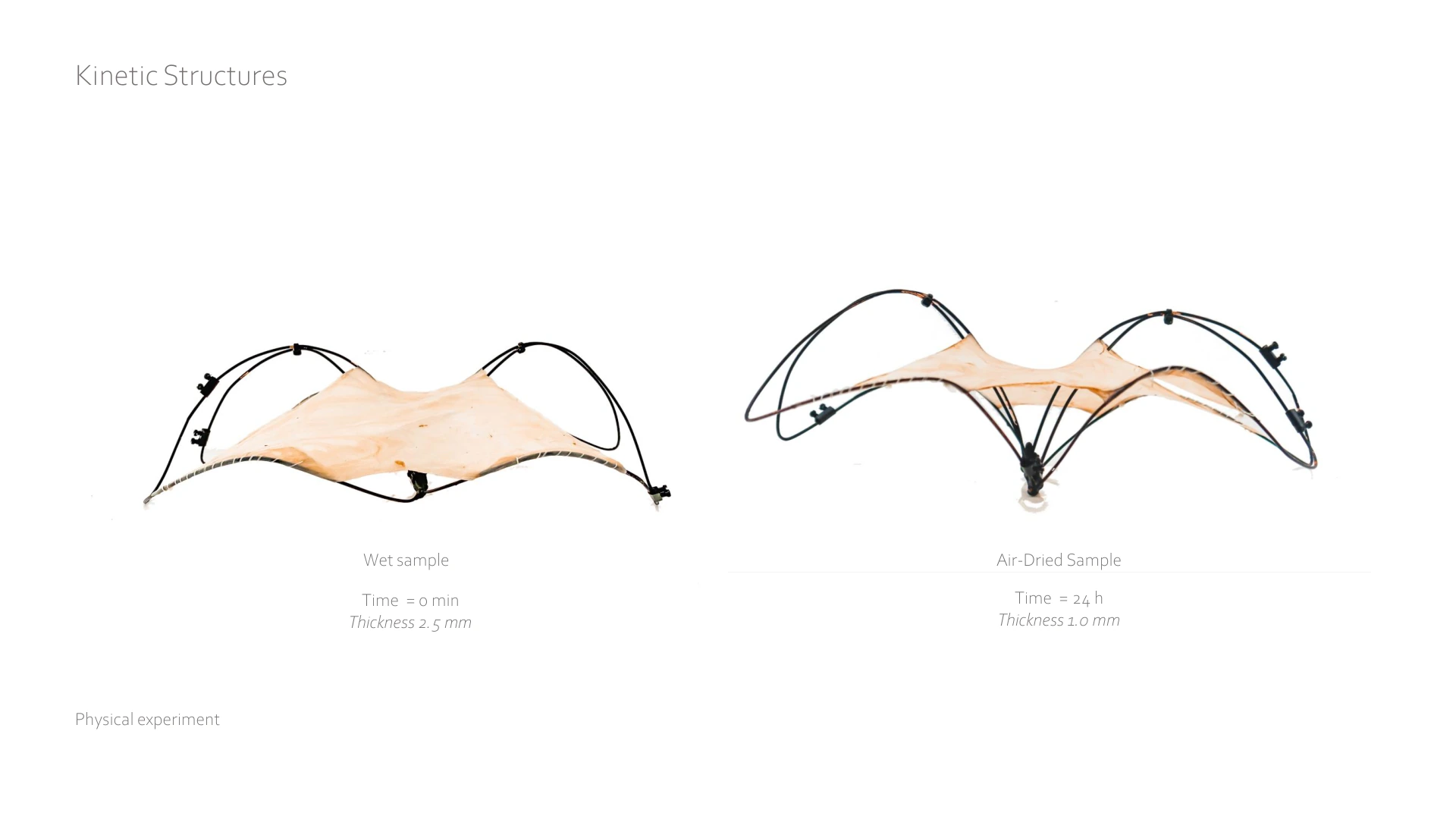
The complete wet and air-dried plate makes the membrane's frame deformation visible without turning it into a performance claim.
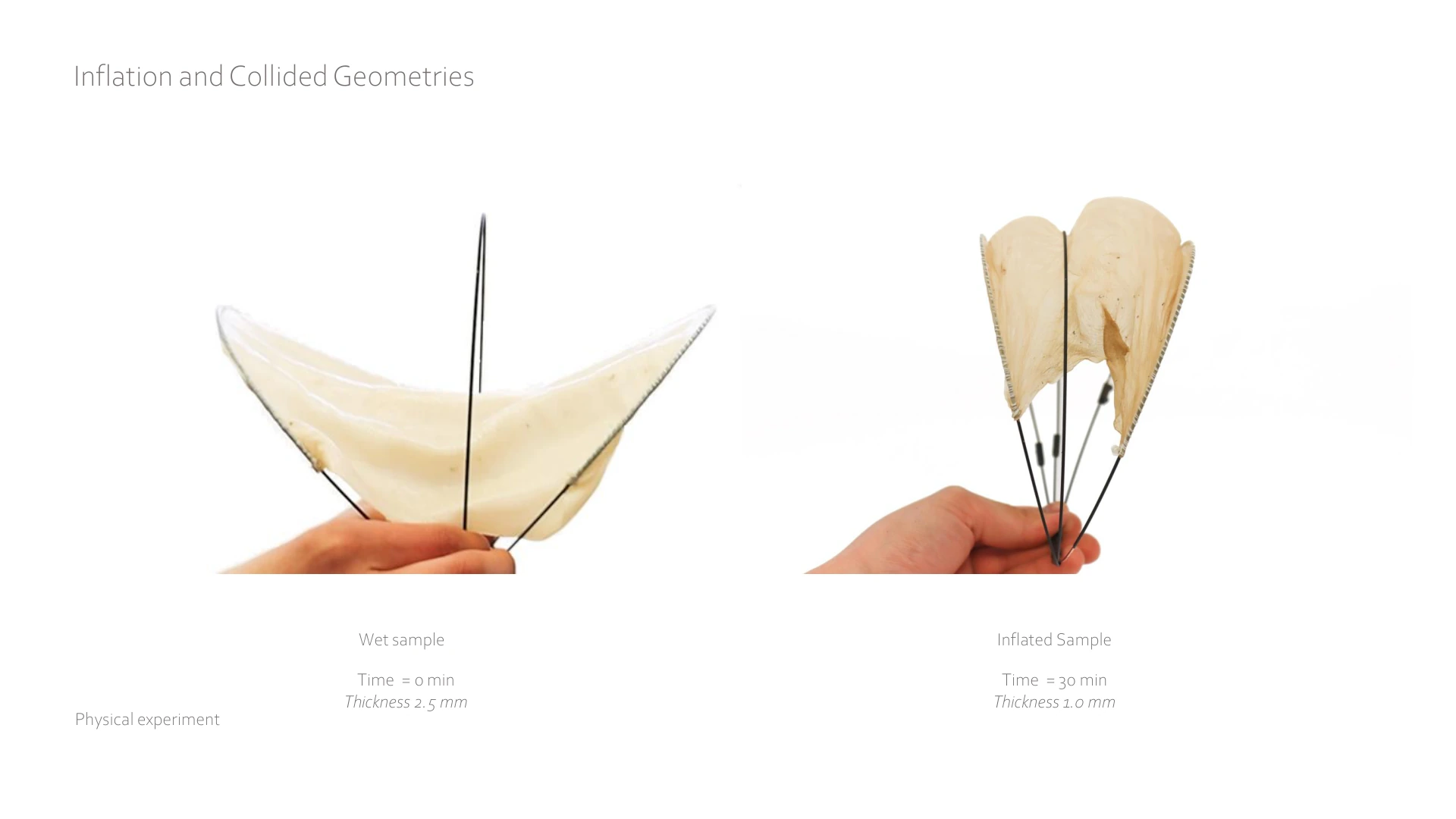
Inflation produced spatial form without resolving edge, load, support or weathering.
Each visible failure produces a more precise variable for the next experiment.
The original technical book introduces the material, team and research context before the experiments begin.
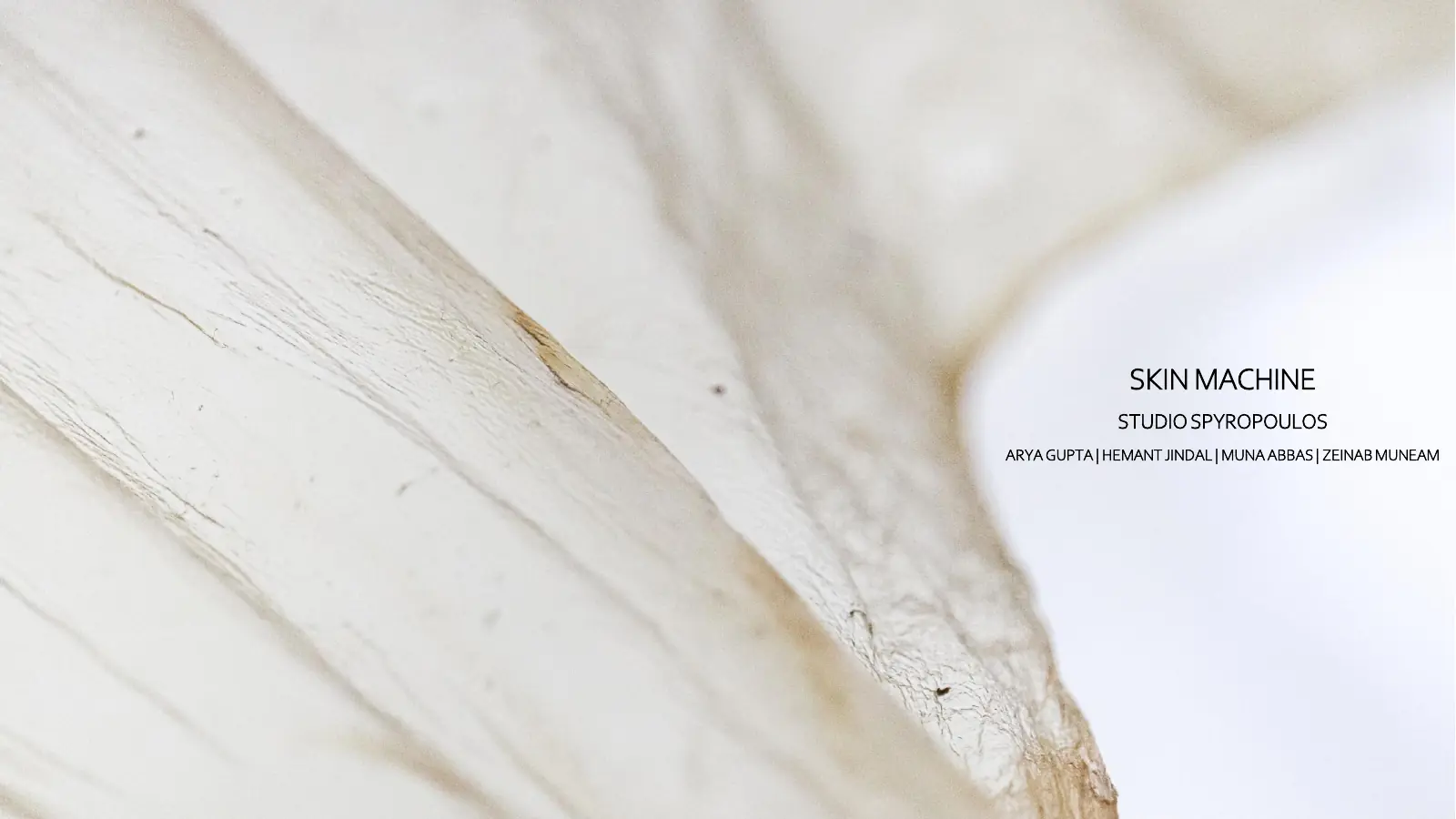
Original technical-book cover / four-person research team.
What changes the way cellulose grows? The experiments varied light, acidity, sugar, glass fibre and plant roots instead of following one fixed recipe.
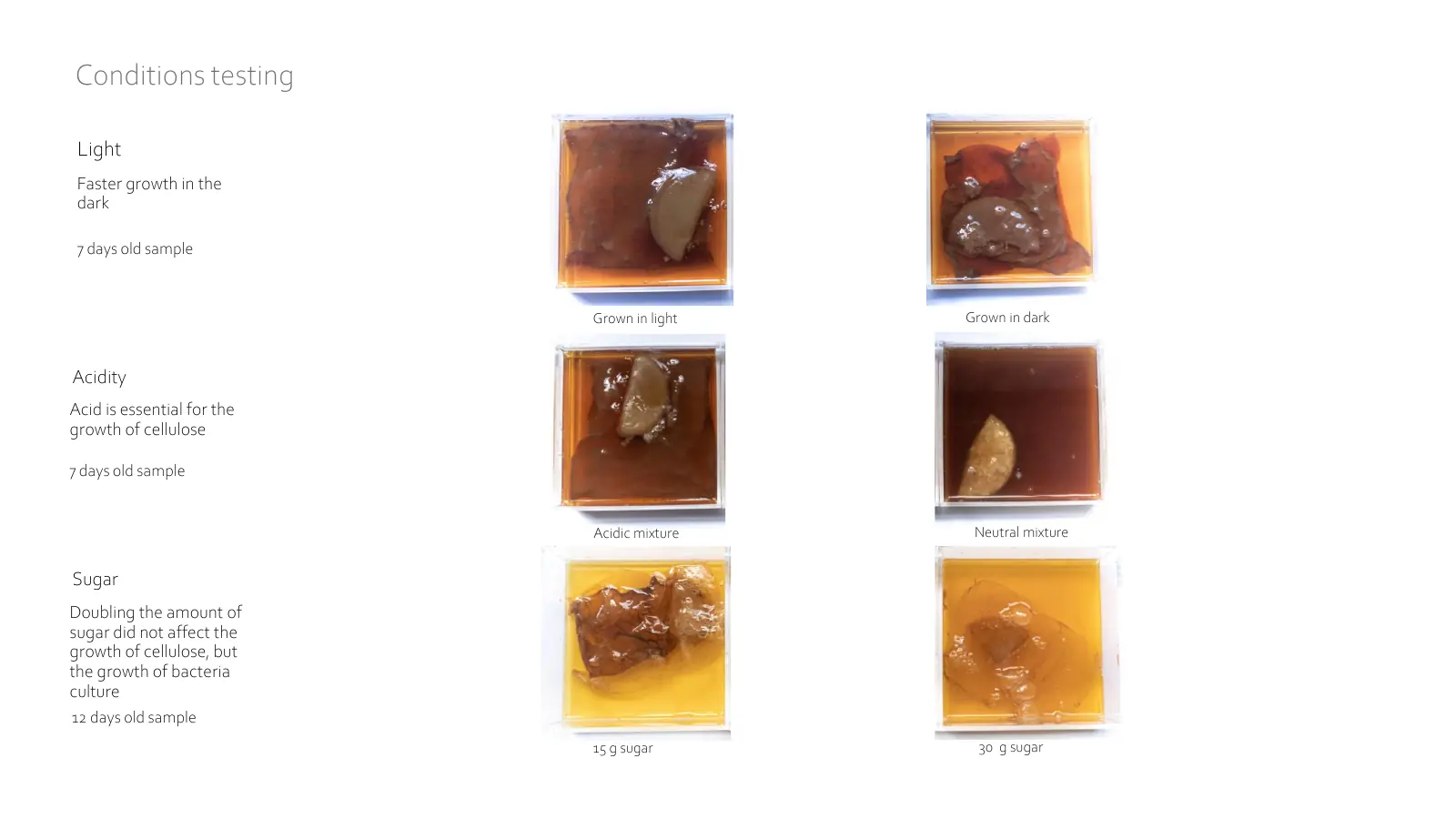
Condition matrix / seven and twelve days.
Can the growth environment make more than a flat sheet? Threads, fabric, porous scaffolds and repeated lifting redirected growth; one sequence produced three joined layers with pockets.
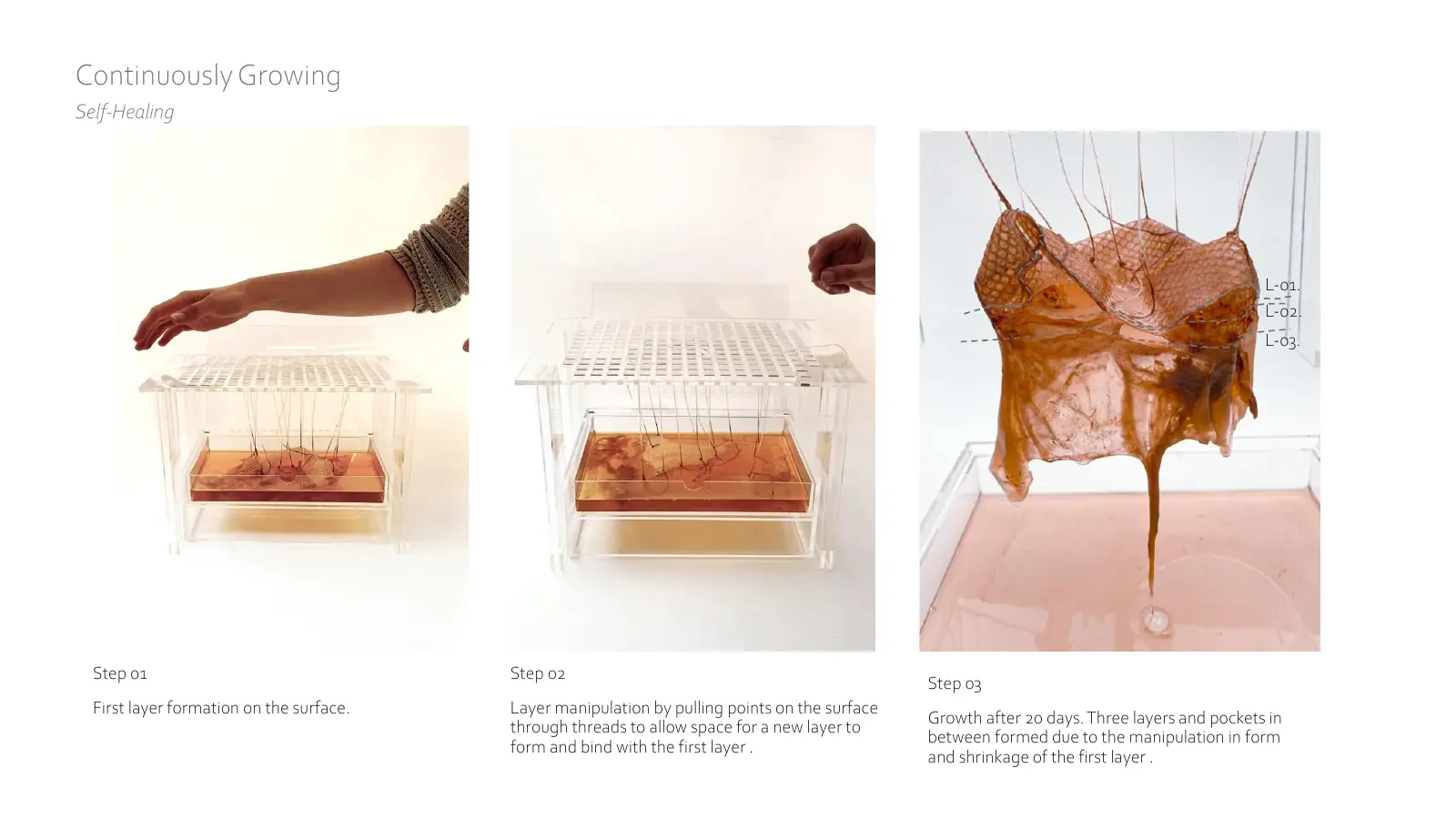
Continuous growth / three layers in twenty days.
What if drying is a second forming process? Air, heat, oil, wax, varnish and water changed thickness, length, transparency, wrinkles and recovery.
Thickness and length change / day zero to fourteen.
Can contraction move a frame? Flexible boundaries turned uneven drying into visible deformation rather than hiding it as a defect.
Booklet p. 44 / wet and air-dried specimens, 0–24 hours.
How can a thin sheet become a three-dimensional form? Inflation, collision, anchoring and smocking produced folds and volume without establishing a certified building envelope.
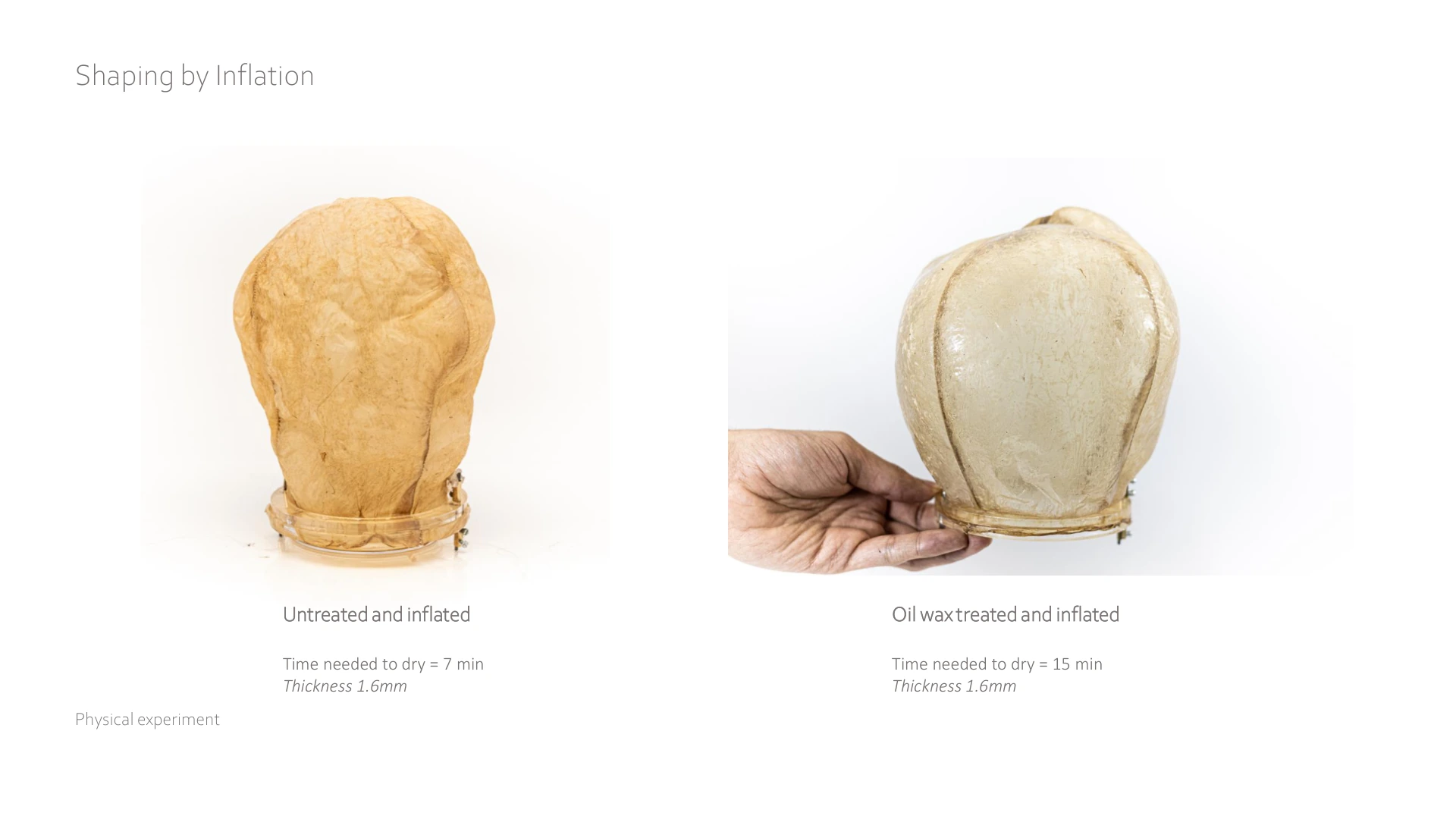
Booklet p. 61 / untreated and oil-wax-treated forms during inflation.
Experiment archive / 25 original plates
Five sequences move from cultivation to spatial assembly. Each starts with a question and ends with a changed material state.
What changes the way cellulose grows?
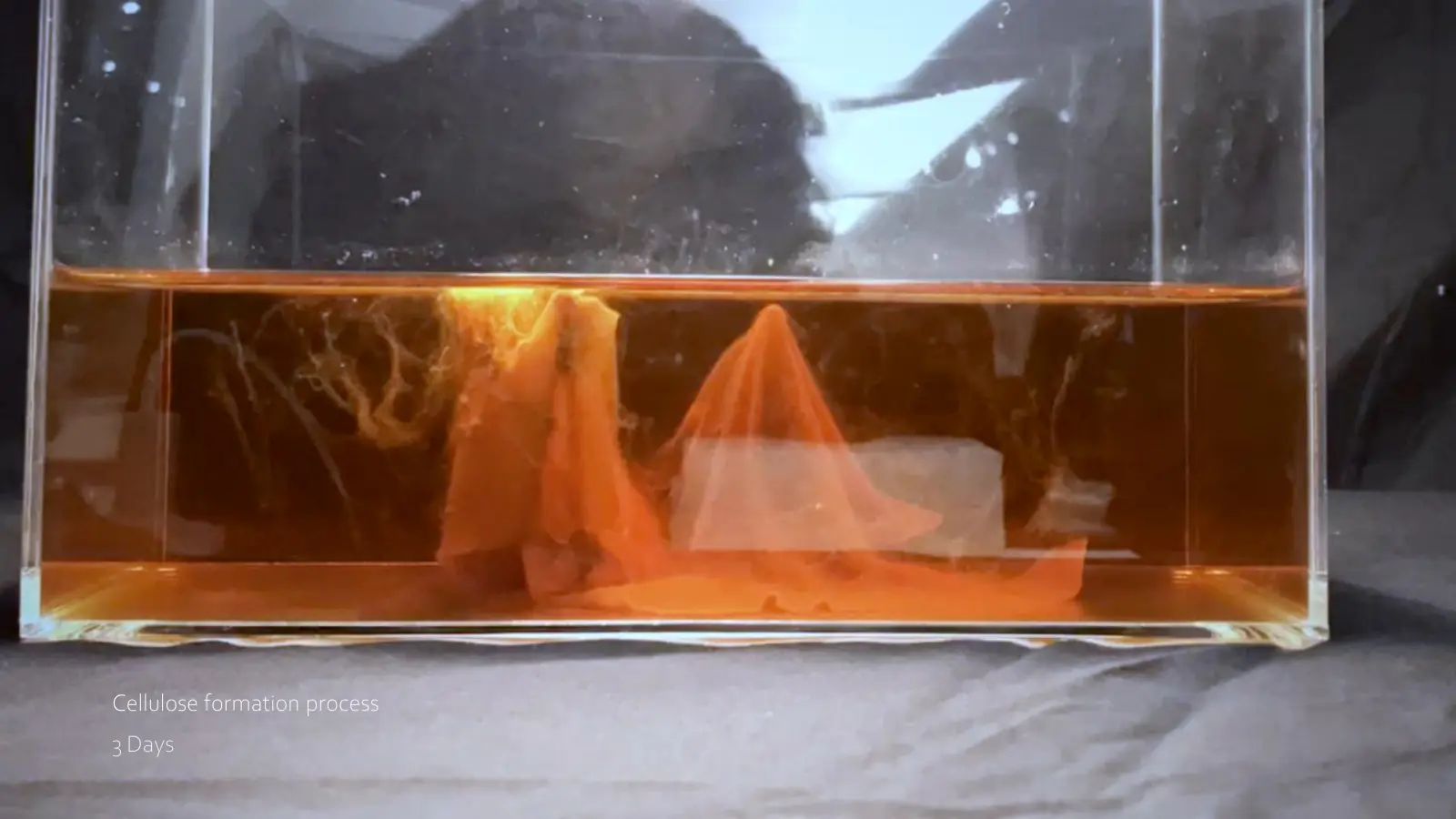
Culture vessel / cellulose formation.
Condition matrix / seven and twelve days.
Glass-fibre composite / eleven days.
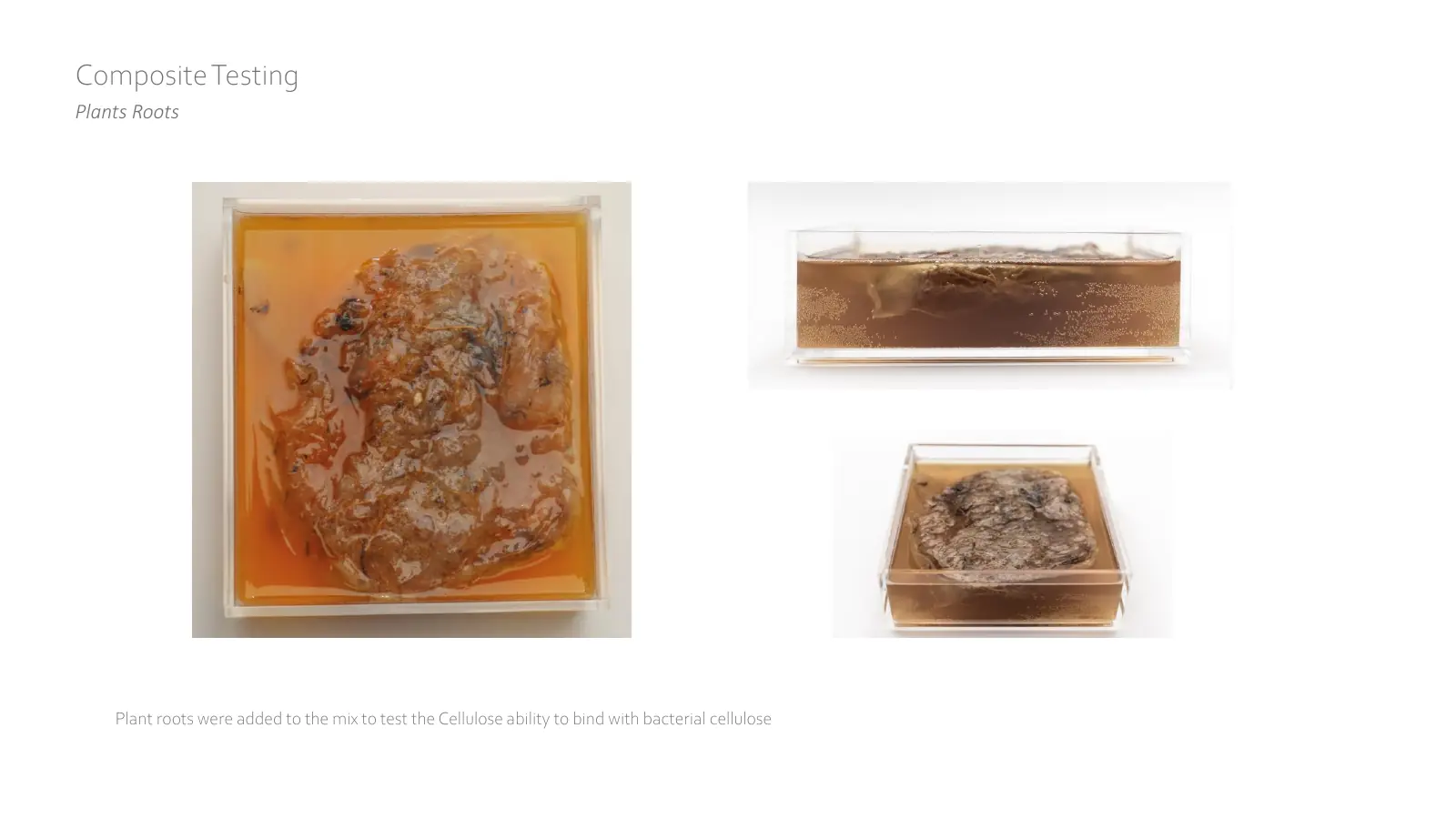
Plant-root composite.
Can the growth environment make more than a flat sheet?
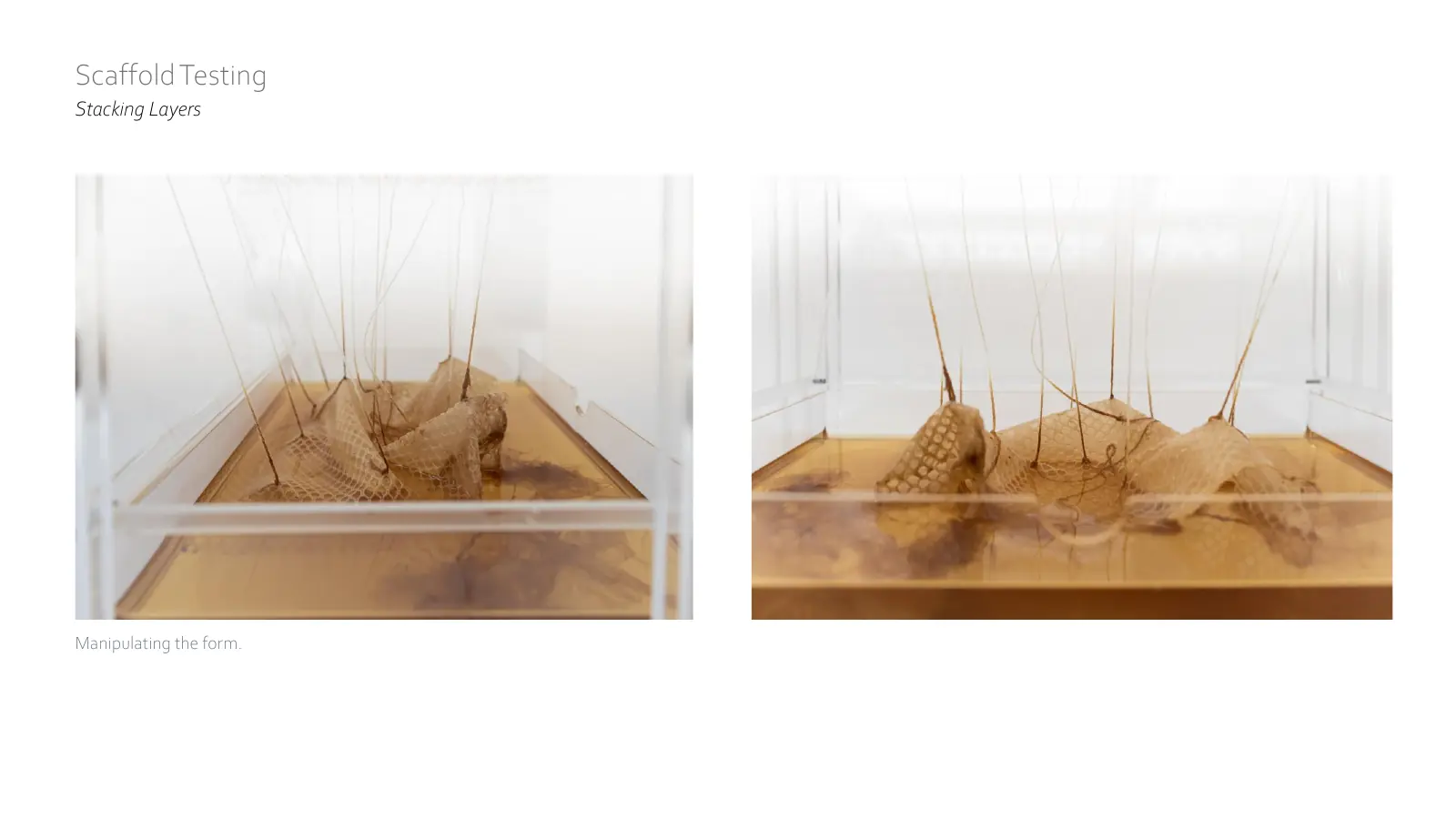
Stacking layers in the growth tray.
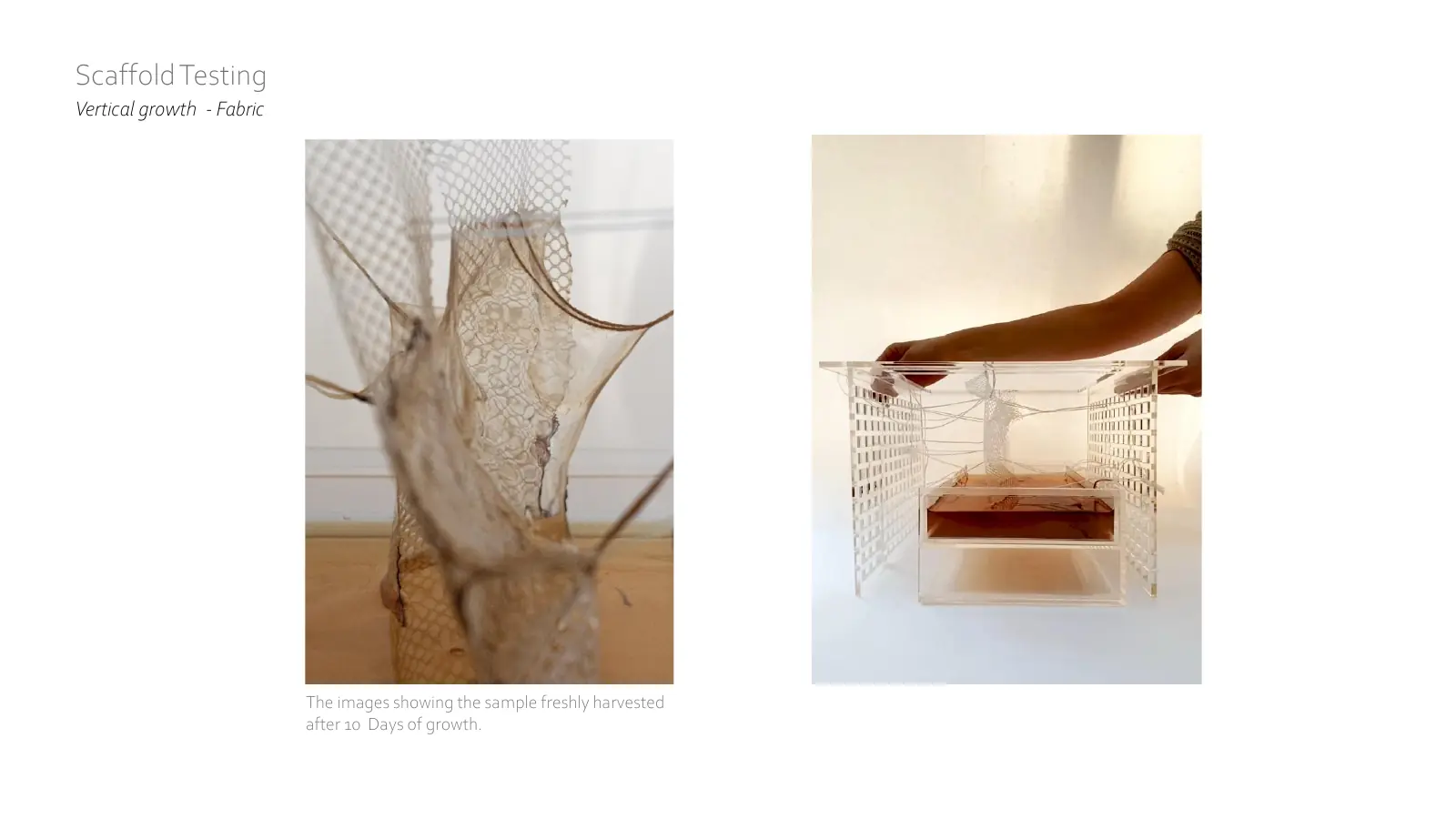
Vertical growth on fabric / ten days.
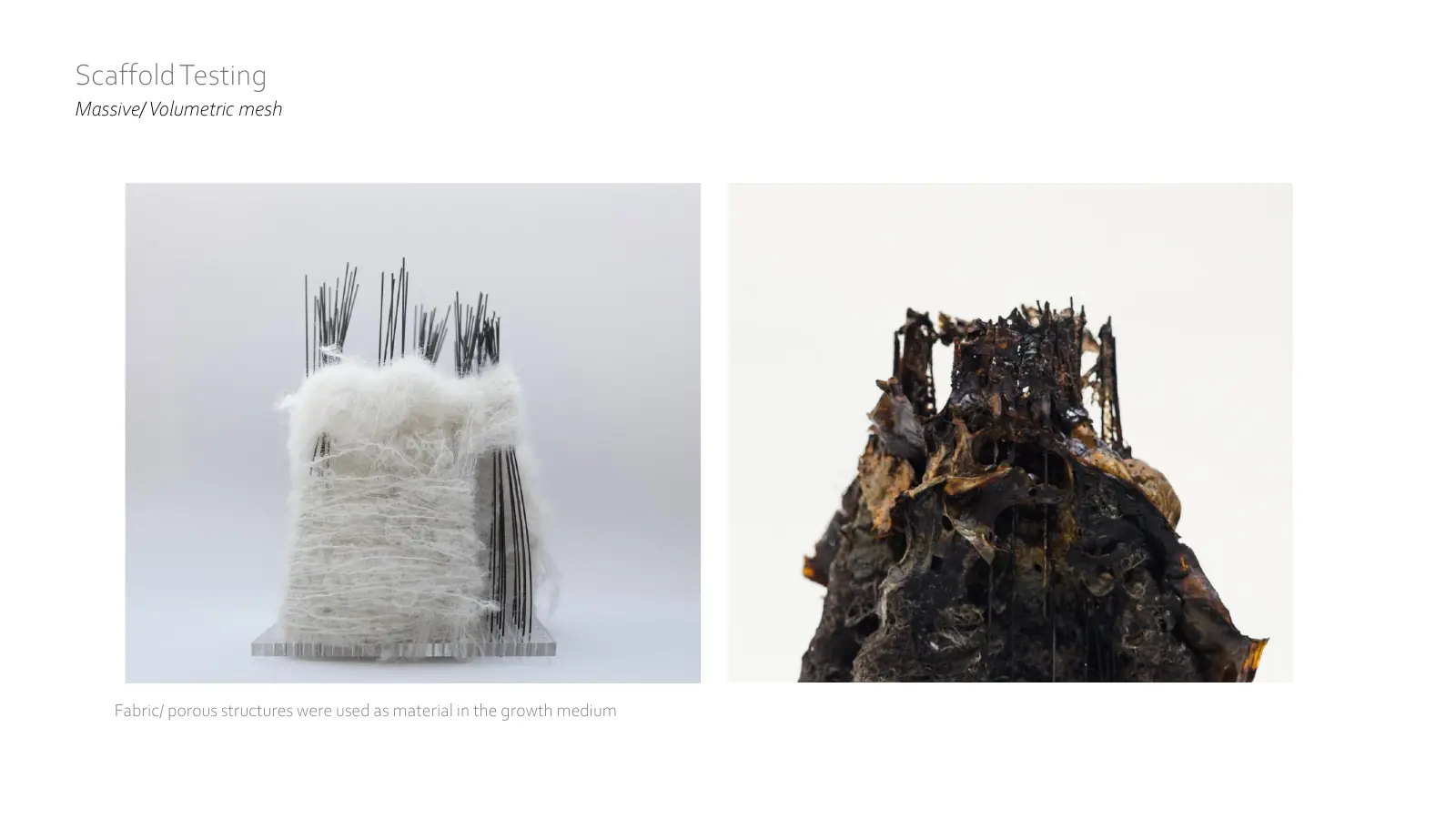
Cellulose growing through a porous scaffold.
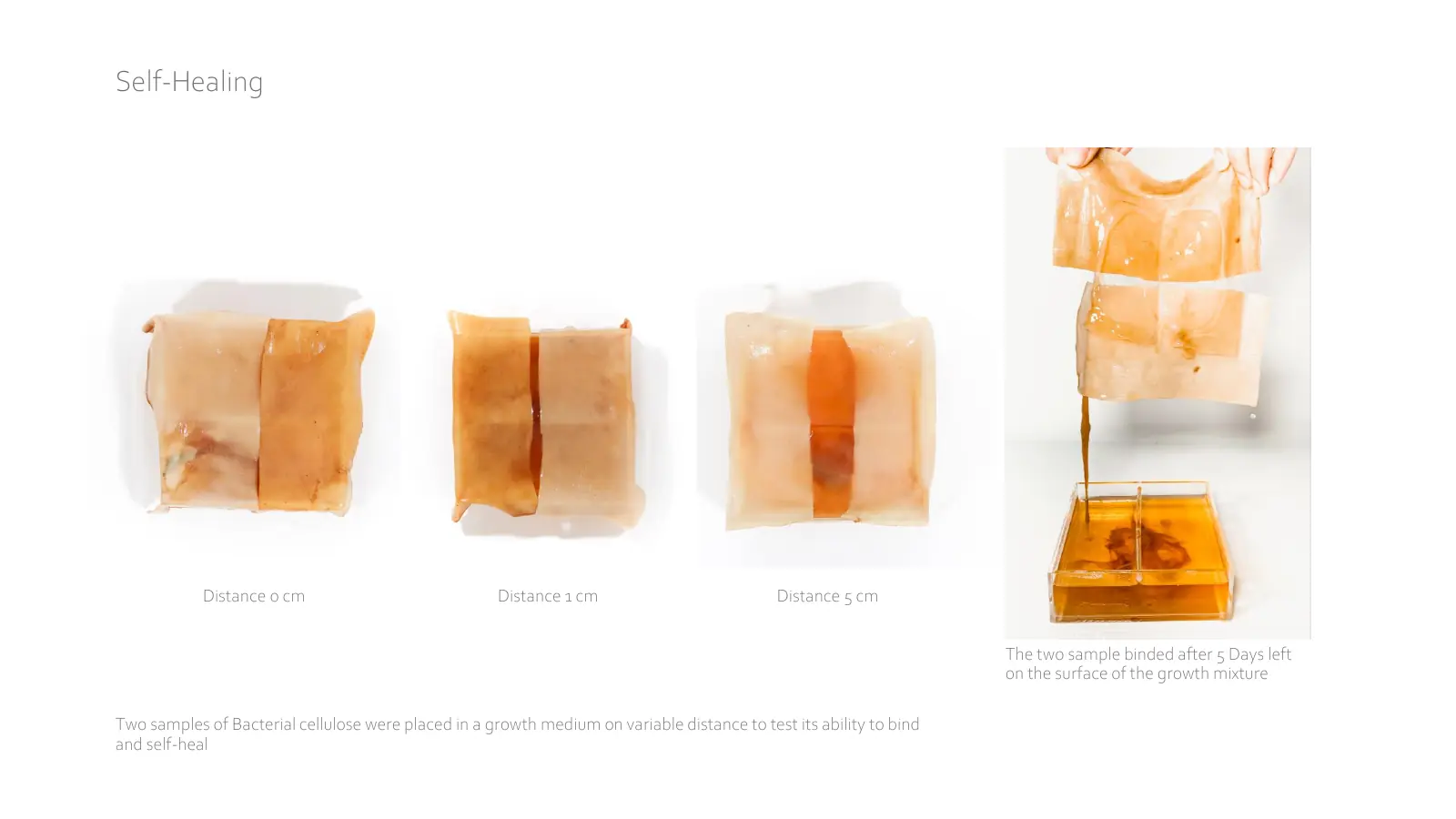
Self-binding across separated specimens.
Continuous growth / three layers in twenty days.
What if drying is a second forming process?
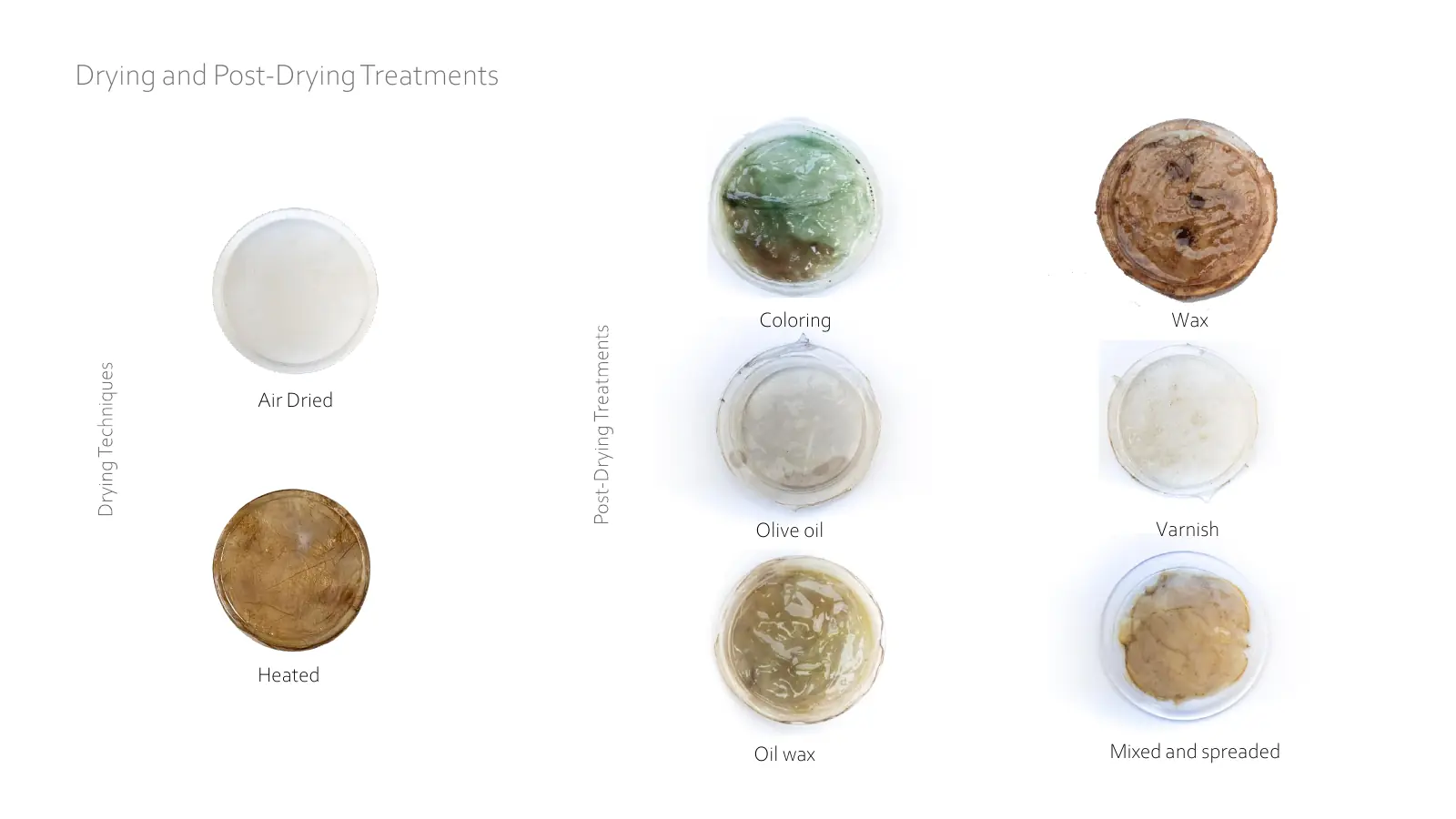
Air, heat, colour, oil, wax and varnish.
Thickness and length change / day zero to fourteen.
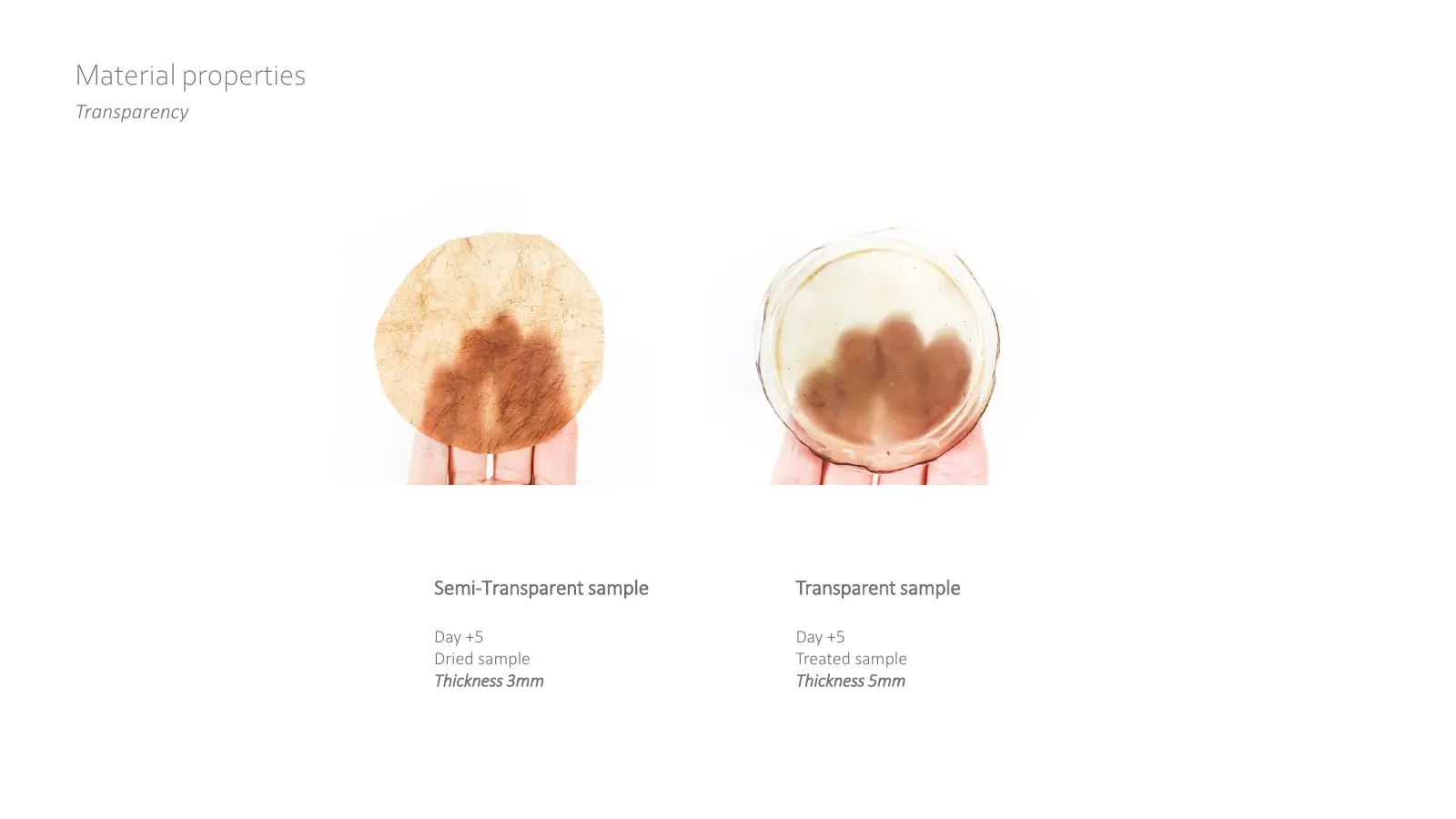
Transparency after drying and treatment.
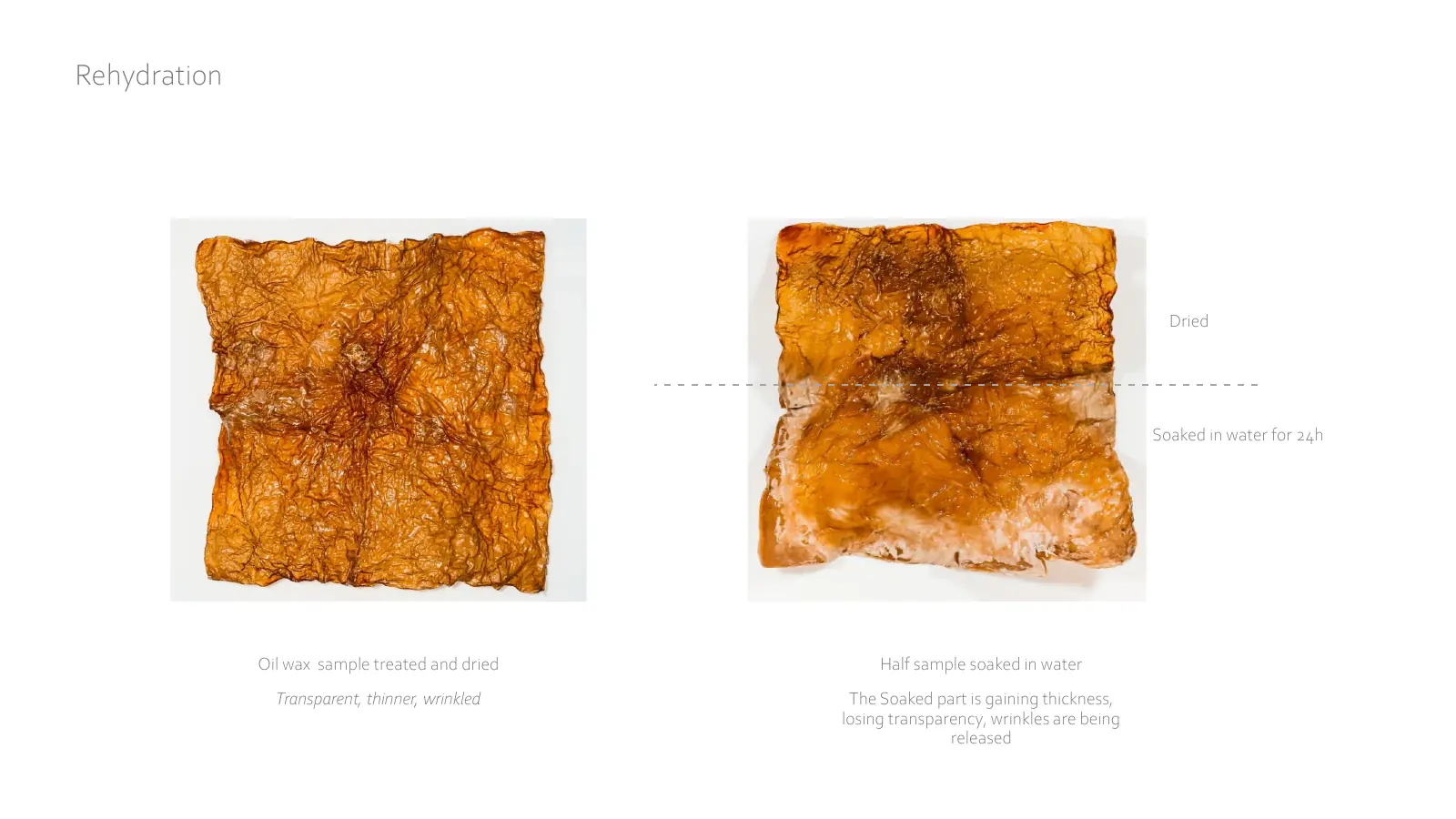
Rehydration released wrinkles and reduced transparency.
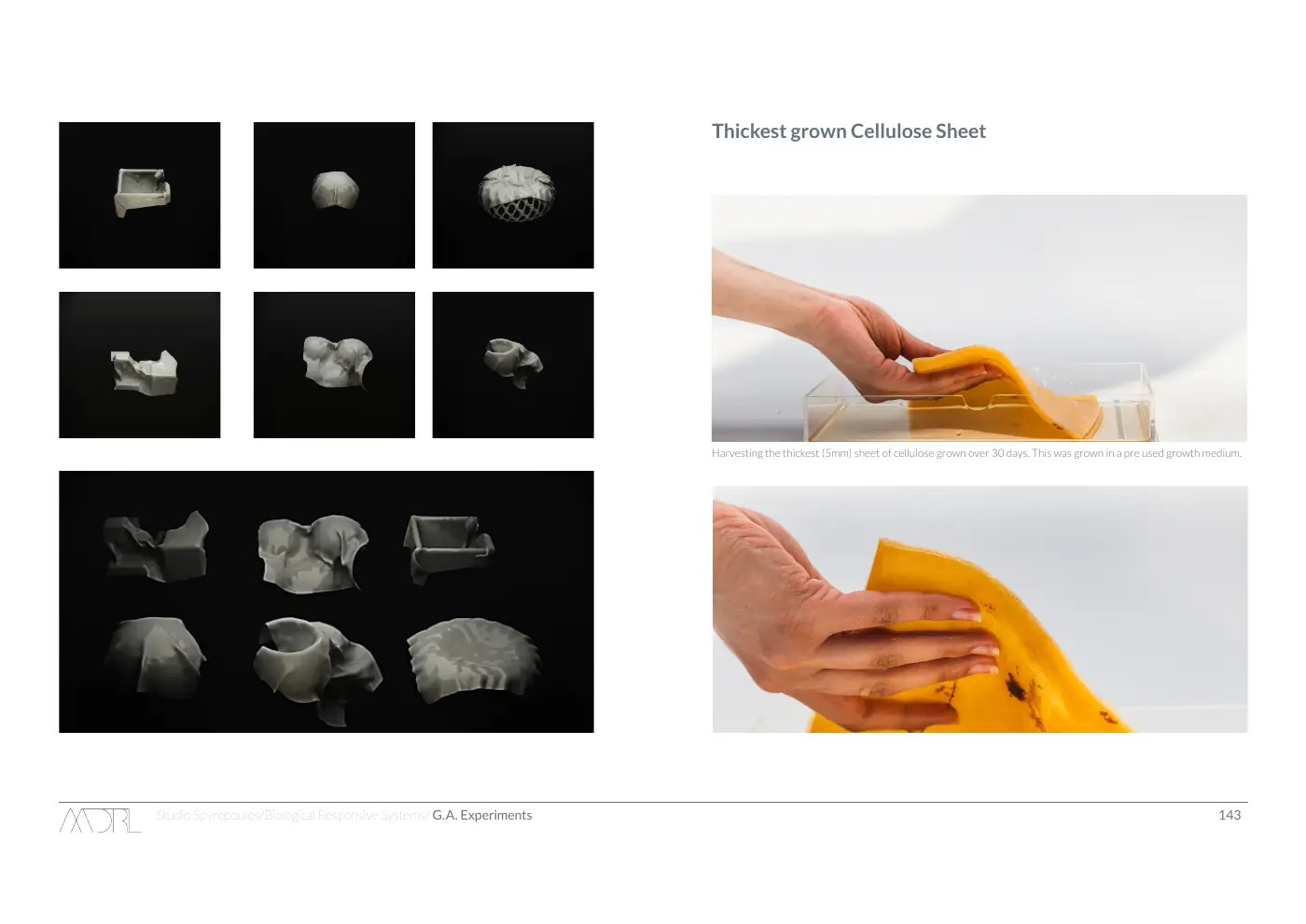
Thickest recorded sheet / thirty days.
Can contraction move a frame?
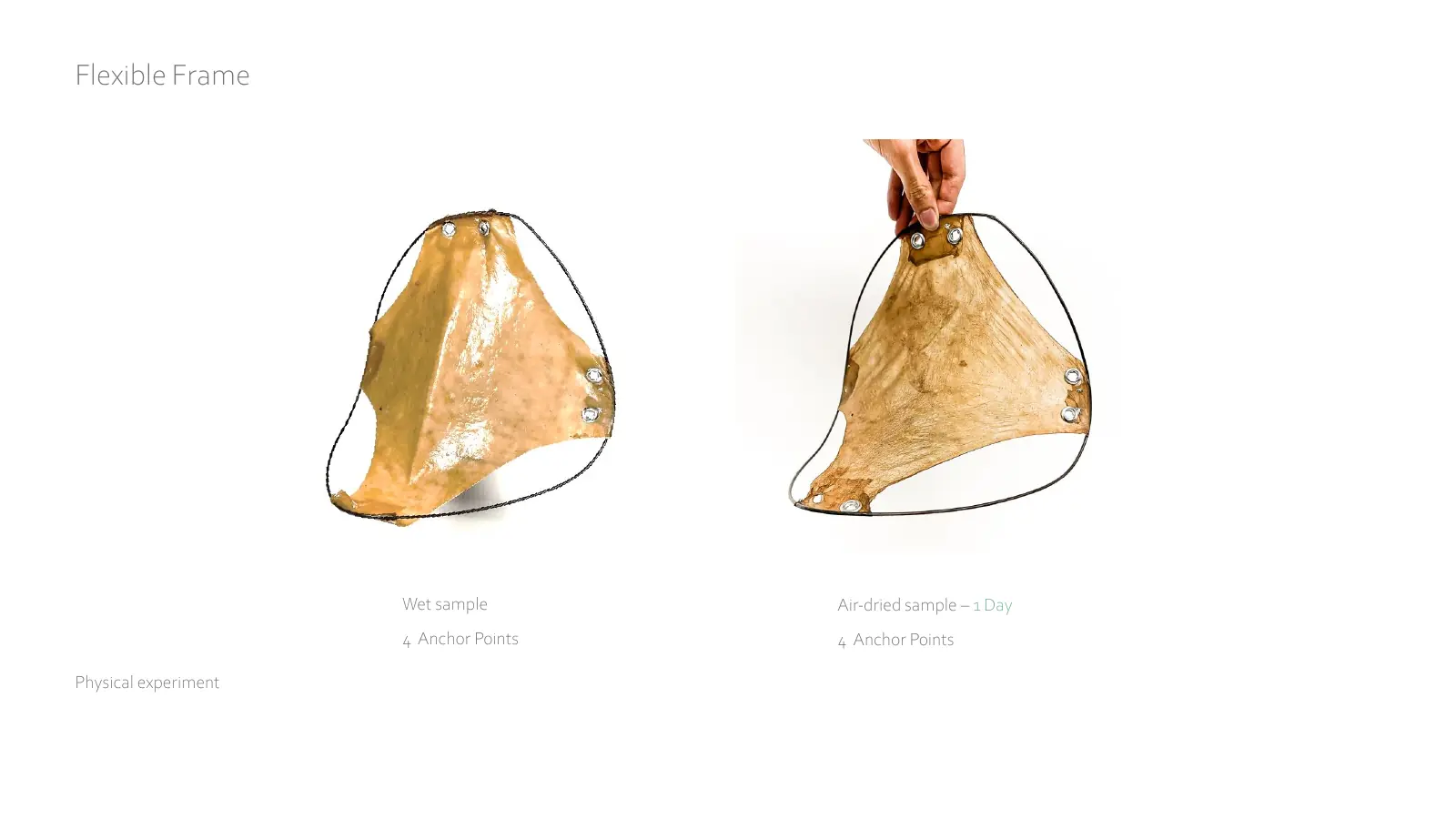
Four-anchor frame / wet and air-dried.
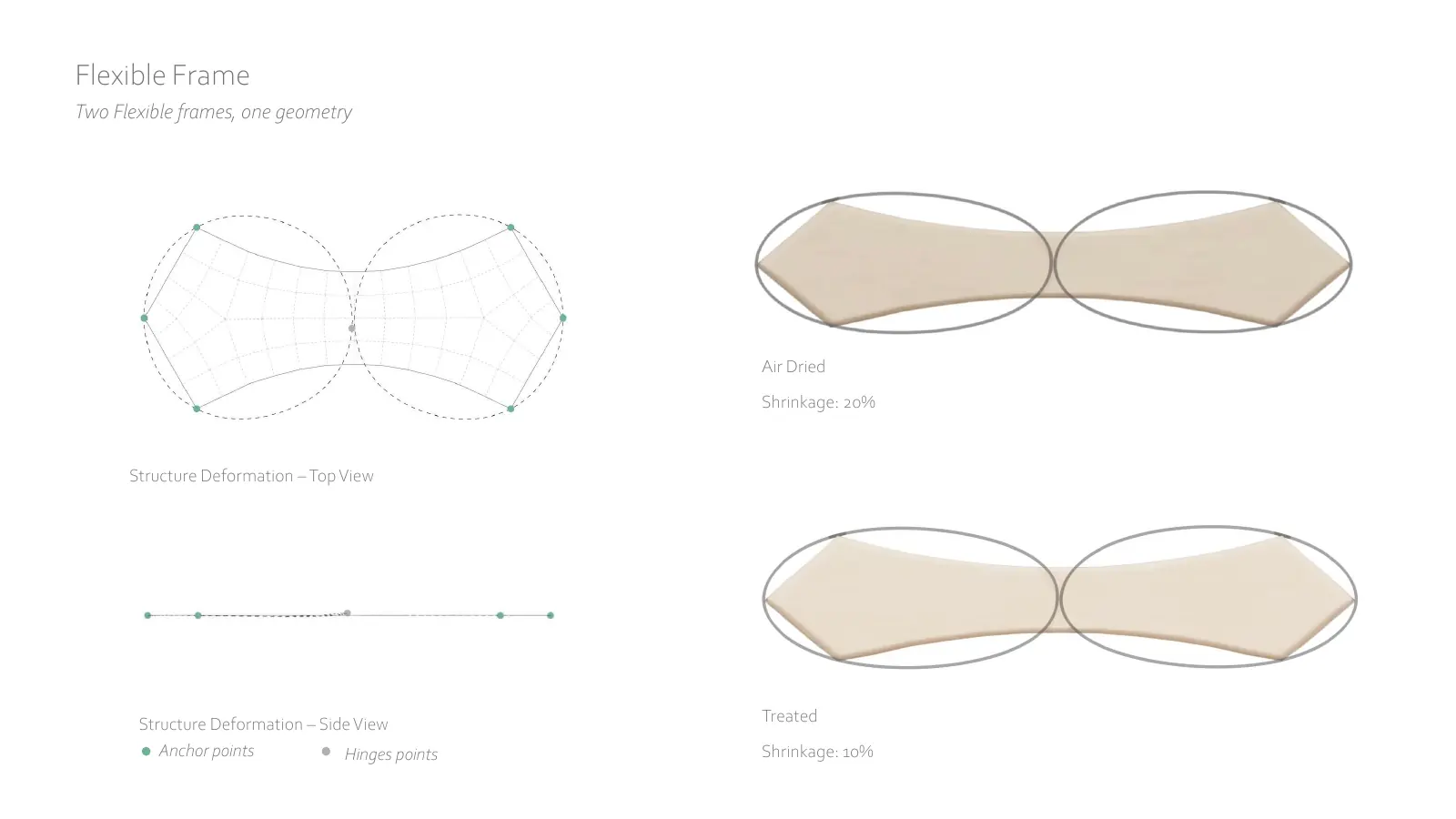
Two-frame deformation study.
Booklet p. 44 / wet and air-dried specimens, 0–24 hours.
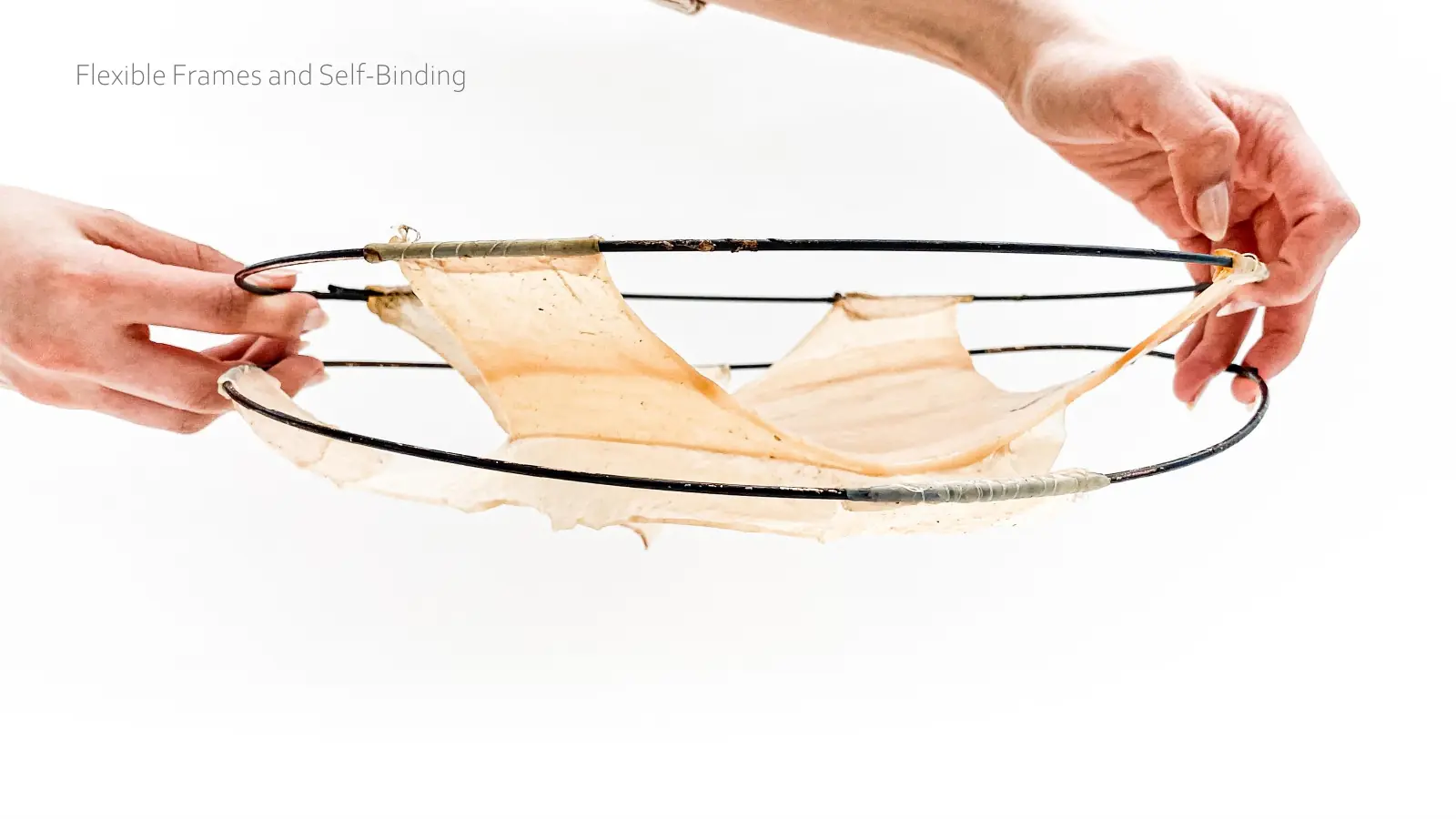
Flexible frame and self-binding.
How can a thin sheet become a three-dimensional form?
Booklet p. 61 / untreated and oil-wax-treated forms during inflation.
Booklet p. 67 / wet and inflated forms after collision.
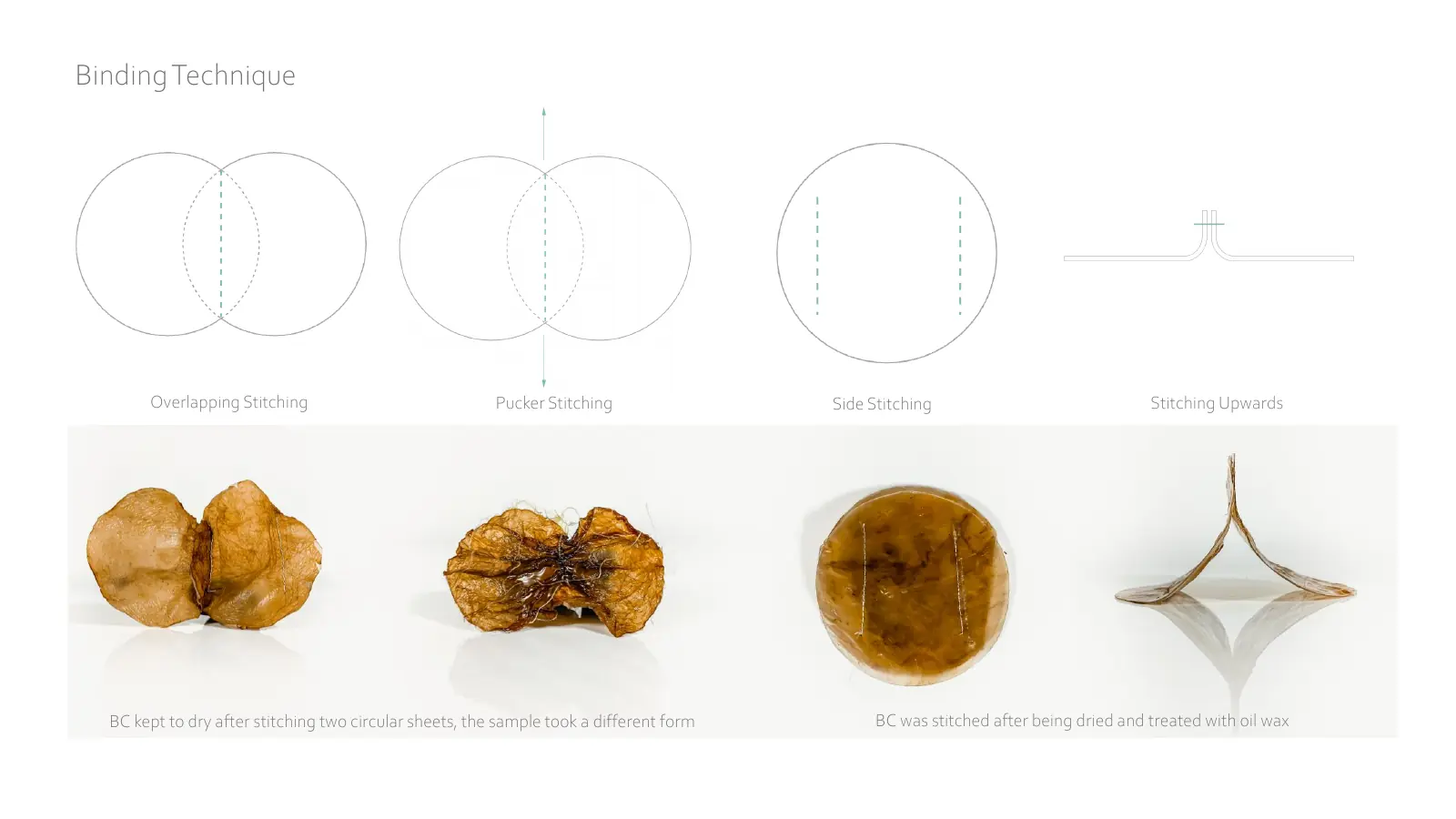
Overlap, pucker, side and upward stitching.
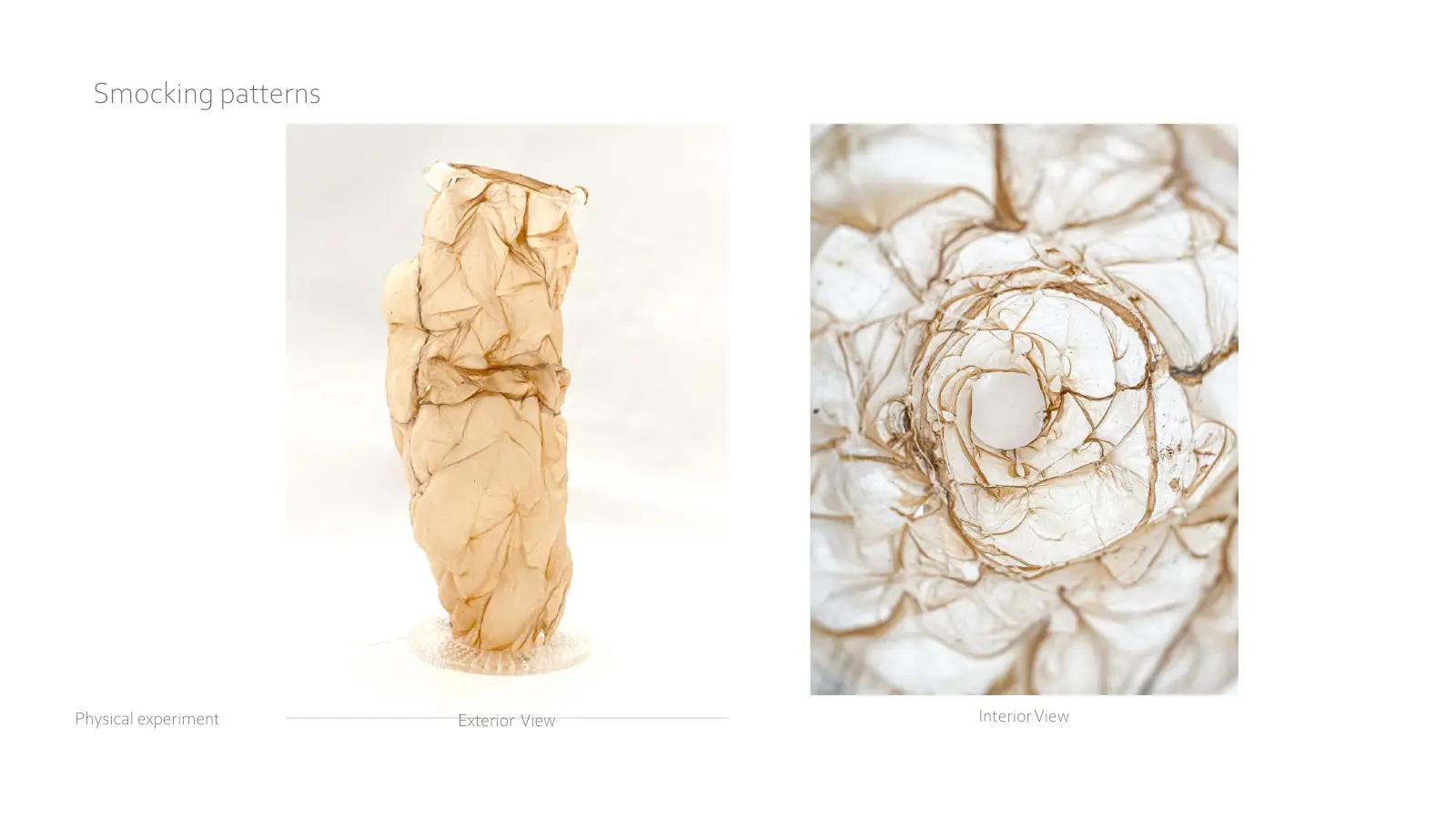
Smocking a flat sheet into a spatial skin.
Open protocol / version 0.1
A material laboratory becomes public when another person can see the conditions, reproduce the sequence and challenge the reading.
Set culture, vessel, light, acidity, medium depth and time.
Introduce a scaffold, fibre, frame or interruption while the membrane forms.
Dry, treat, rehydrate or inflate under recorded boundary conditions.
Measure the change; photograph the failure; separate observation from claim.
Change one variable, retain the failed specimen and publish the next question.
System study / unbuilt
The final study brings cultivation, sensing and movement together in an unbuilt cellulose-growing machine design.
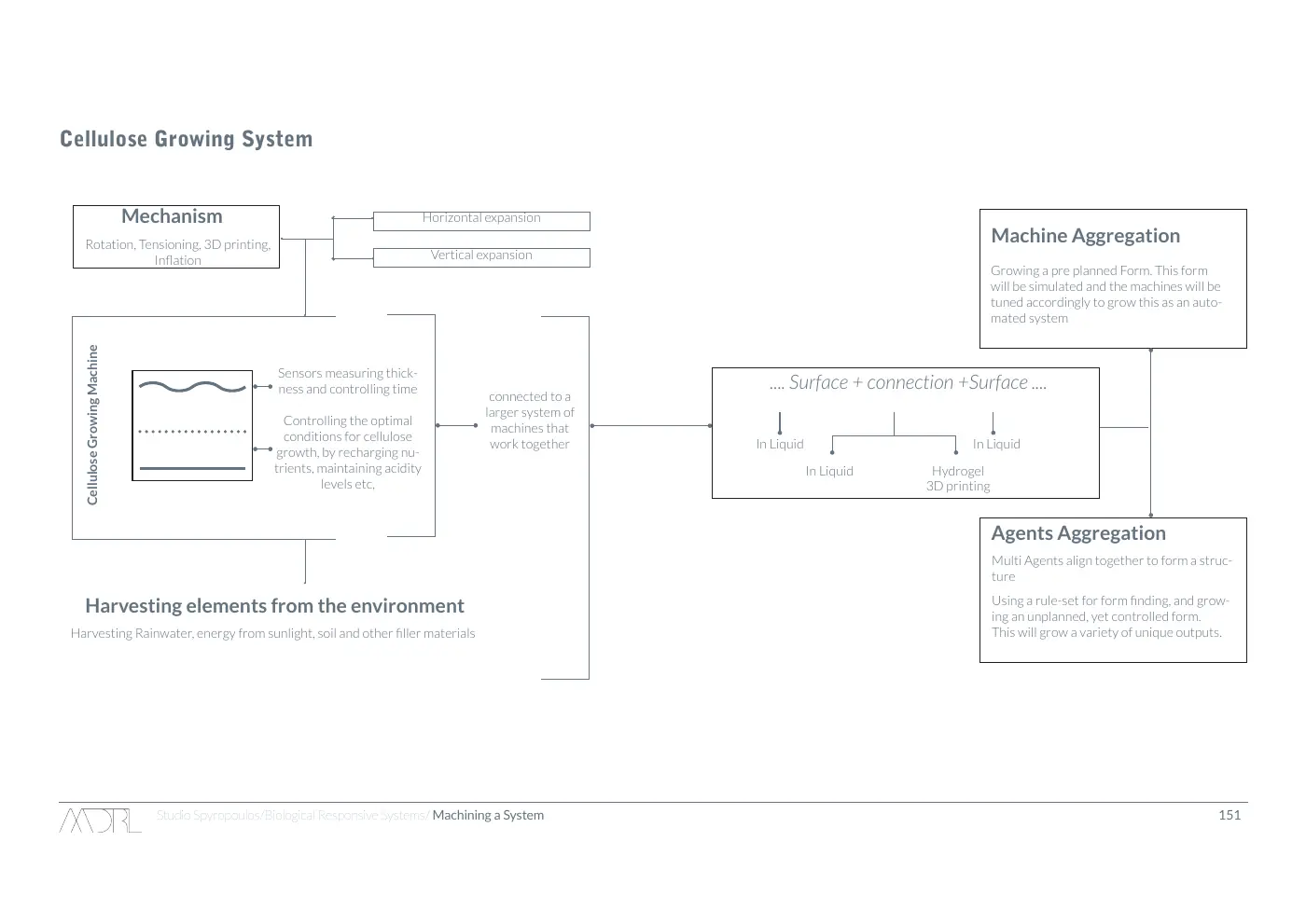
Unbuilt cellulose-growing system: mechanisms, sensing and growth.
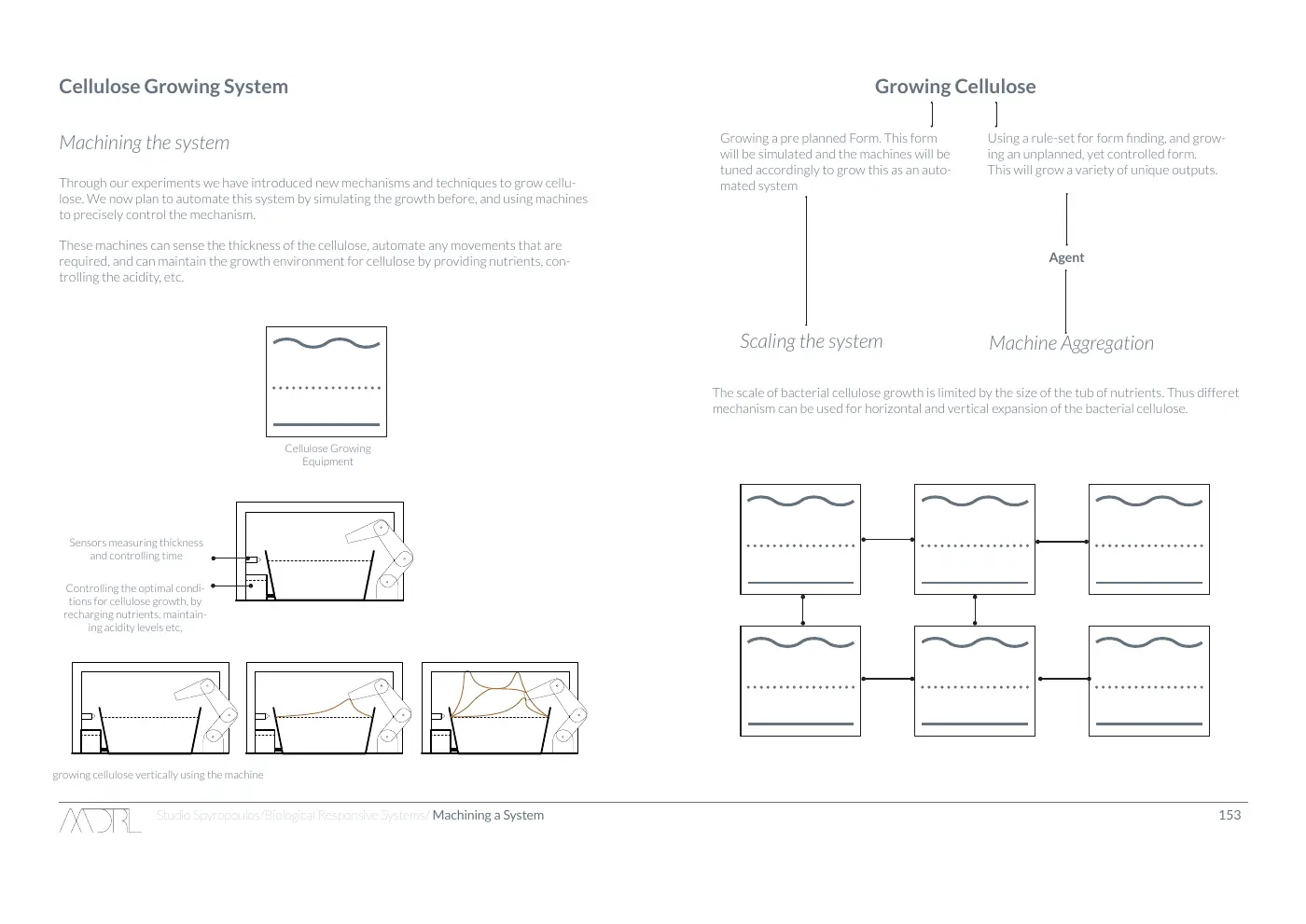
Unbuilt machine design for a growing system.
The system study develops observed material change into a speculative unbuilt machine design.
Evidence layer
Open research programme
Matched batches with fixed culture, vessel, temperature, time and harvest method.
Wet and dry specimens tested with stated geometry and conditioning.
Joints, weathering, fire response and one larger repeatable panel.
Authorship / full project record
Skin Machine was developed by Arya Gupta, Hemant Jindal, Muna Abbas and Zeinab Muneam at the Architectural Association Design Research Laboratory, Studio Spyropoulos / Biological Responsive Systems.
Reconstructed and presented by Hemant Jindal. Only responsibilities verified in the archive are stated here.
Publication details
Arya Gupta, Hemant Jindal, Muna Abbas and Zeinab Muneam. “Skin Machine: Material Failure Atlas.” Field Assembly, Issue 01. Published 1 August 2026; revised 14 September 2026. https://fieldassembly.press/skin-machine.
In brief
Cultivation becomes fabrication when biological variation is observed, compared and deliberately used.
What’s included The original material specimen and failure atlas