Motus Gridia proposes a network of self-governing settlements called Grids. This study takes a community that pools resources and follows how that choice could shape its housing and shared spaces.
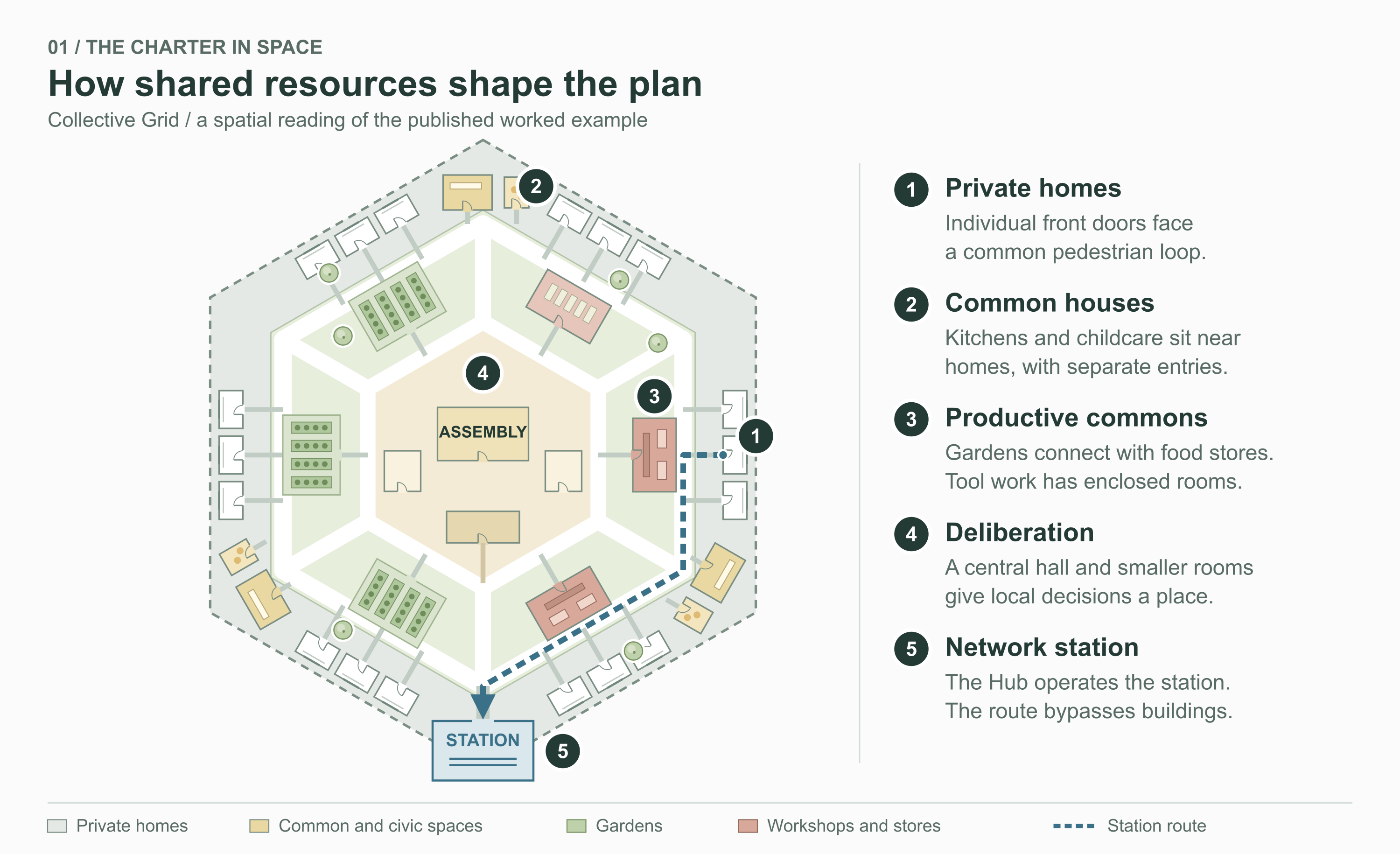
It begins at a private front door, then follows a resident into the commons. The plan connects shared food spaces to homes and gives pooled tools a place for use and upkeep. A hall and smaller deliberation rooms give collective decisions a place. Private thresholds remain distinct from the shared spaces.
A spatial reading of the proposed Collective Grid. Separate front doors meet a common loop; shared resources and deliberation spaces sit within it. No site, scale or dimensional performance is established.Motus Gridia, project by Shaan Khan. Contributor-supplied diagram prepared from the project whitepaper.Open full-size image
Reading the plan
Private homes: individual front doors face a common pedestrian loop.
Common houses: kitchens and childcare are proposed near homes, with separate entries.
Productive commons: gardens connect with food stores; enclosed rooms provide space for tool work.
Deliberation: a central hall and smaller rooms give local decisions a place.
Network station: the drawing assigns its operation to the Hub and shows a route that bypasses buildings.
Keep the route beyond the community
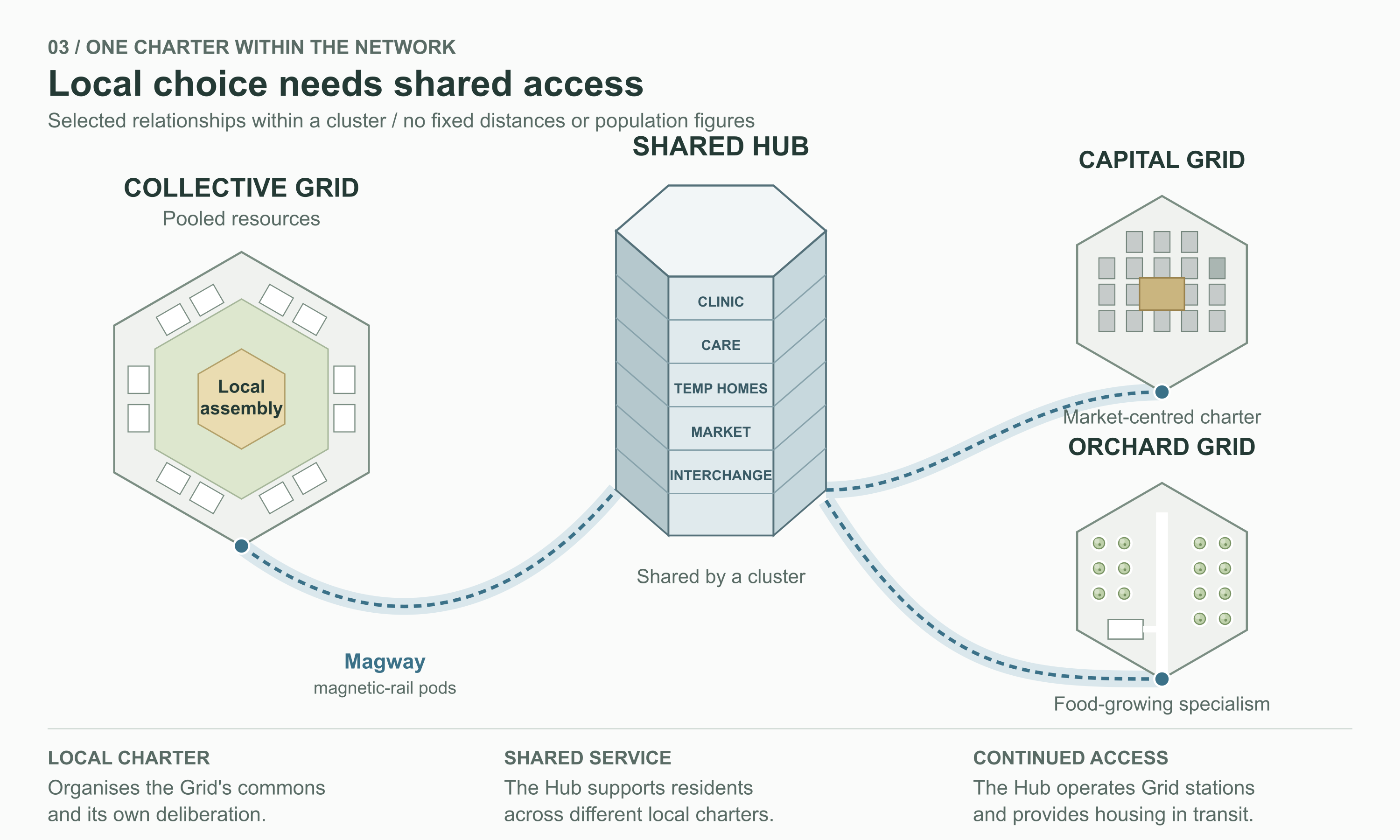
The final diagram looks beyond the Grid. It presents the Hub as a separate service centre shared by communities with different charters and assigns operation of each Grid's station to that Hub. Continued access to care and the ability to leave become part of the architectural proposition, not only the local community's internal rules.
Local charter, shared services and continued access are presented as different layers. The drawing proposes connections, not fixed distances, a delivered transport system or verified service provision.Motus Gridia, project by Shaan Khan. Contributor-supplied diagram prepared from the project whitepaper.Open full-size image
Reading the network
Local charter: organises the Grid's commons and its own deliberation. Shared service: the proposed Hub would support residents across different local charters. Continued access: the Hub would operate Grid stations and provide housing in transit. Magway is the proposal's magnetic-rail connection, not an established transport service.
Sources and credits
Unbuilt proposal. The contributor describes relationships rather than a fixed site or dimensioned design. The drawings do not document an existing settlement, residents or tested outcomes.
Project and text: Shaan Khan. Visual credit: Motus Gridia, project by Shaan Khan. The contributor says the two diagrams were prepared from the project whitepaper; no whitepaper text is reproduced here.
The plan and network keys transcribe the contributor's drawings so their labels remain readable on a small screen. They do not verify that the proposed arrangements would deliver the intended social outcomes.
Shaan Khan. “Collective Grid: how a charter becomes a place.” Field Assembly, Issue 02. Published 31 October 2026. https://fieldassembly.press/articles/collective-grid-how-a-charter-becomes-a-place.